
There’s a growing gap between what a business knows about itself and what the internet is quietly saying on its behalf.
Increasingly, that “internet” isn’t a person, a review site or even a search result in the traditional sense. It’s an AI model answering a question in real time – confidently, fluently, and sometimes incorrectly.
New data from Atlas Digital points to what it describes as an “AI reputation breach.” That is, a situation where businesses are being misrepresented, misquoted or simply left out of AI-generated answers across platforms like ChatGPT, Google Gemini, Perplexity AI and Claude. The issue is not dramatic in the way a data breach might be. There are no alarms, no locked accounts, no obvious moment of failure. Instead, it happens in the background of everyday decision-making, where customers are increasingly asking AI what to buy, who to trust, and which company fits their needs.
And the answers are not always accurate.
Across audits spanning SaaS, technology and financial services companies, Atlas Digital found that 72 per cent of brands had at least one factual error in AI-generated responses. Seventy per cent failed to appear in AI recommendations within their own category. More than 80 per cent of users, meanwhile, do not verify whether the information they receive from AI is correct.
It’s a combination that creates a very modern problem: misinformation that feels like certainty.
The scale of the issue becomes clearer when viewed through behaviour, rather than technology. AI is no longer a novelty tool sitting on the side of search. It is increasingly part of how decisions are made. Consumers are asking it what software to use, which financial services to consider, and which companies are most relevant to their needs. In that moment, visibility is no longer about ranking on page one of Google. It’s about whether a business appears in the answer at all.
Ryan McMillan, Founder and CEO of Atlas Digital, describes it as a shift in how reputation itself is formed. AI, he argues, is now acting as a kind of front door to decision-making. But, without the accountability structures that usually come with information channels. There is no corrections process. No way for a business to flag that something is wrong. The customer simply moves on, often without the business ever knowing it was misrepresented.
What makes this particularly challenging is how quietly it compounds. A slightly outdated product description. A service offering that has changed but hasn’t been reflected in third-party data. A legacy feature that continues to surface in AI outputs long after it has been removed. Individually, these seem minor. Together, they shape a version of a business that may no longer exist.
In one example from Atlas Digital’s analysis, a technology company was found to have only 44 per cent accuracy in AI-generated descriptions of its services. Across 31 third-party platforms, every listing contained outdated or incorrect information. In another case, a financial services provider was attributed with policies and fees that did not exist at all.
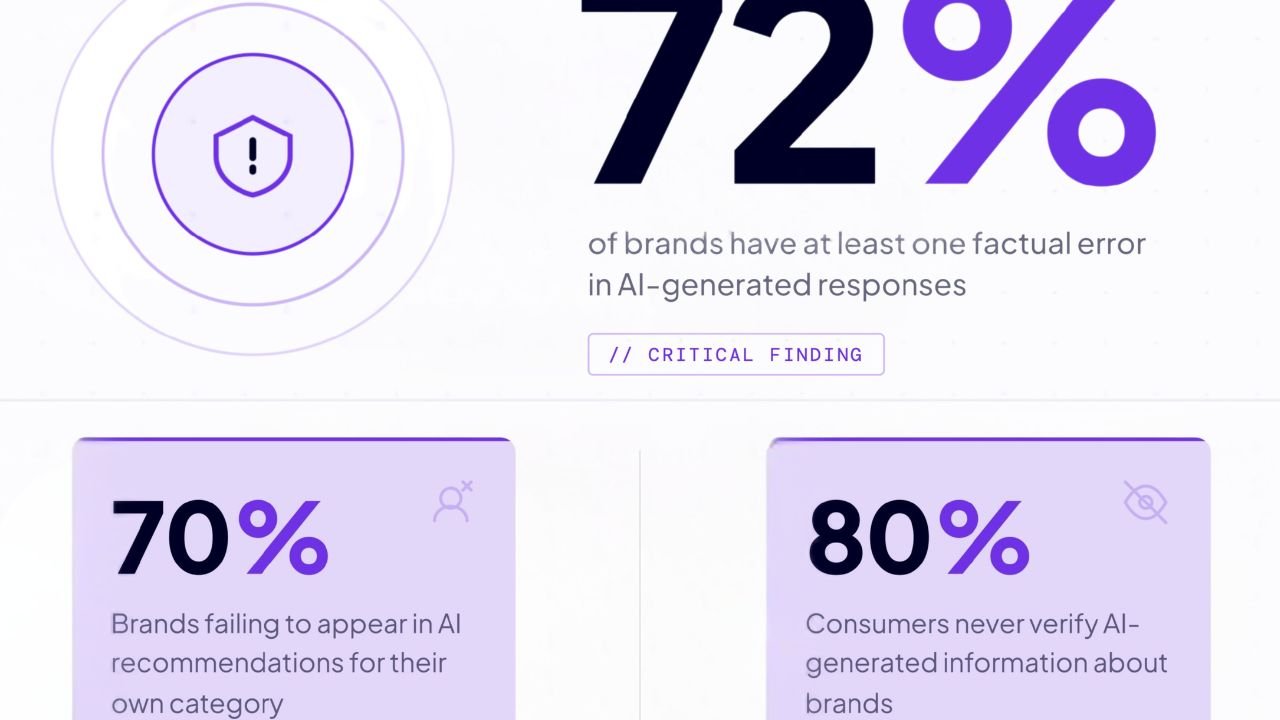
The issue is not limited to errors alone. Visibility is just as inconsistent. Seventy per cent of brands did not appear in AI recommendations for their own category. This effectively renders them invisible in the very spaces where customers are increasingly making early-stage decisions.
Alla Lvovich (main feature image) Organic Product Lead at Atlas Digital, points to the speed at which this is becoming commercially relevant. ChatGPT alone now reaches more than 900 million weekly users, while Google’s AI Overviews are being surfaced to billions globally. In Australia, AI-driven referral traffic to websites has grown significantly year-on-year, and nearly half of consumers now use AI to inform purchasing decisions.
Crucially, that traffic behaves differently. AI-led referrals convert at rates between 12 and 17 per cent, compared to roughly 3 per cent for traditional search. In practical terms, this means that inaccuracies are not just reputational – they are directly tied to revenue outcomes.
There is also the question of reliability at model level. Hallucination rates across major AI systems still range widely, with some models generating fabricated or incorrect information between 15 and 52 per cent of the time. When those outputs are repeated across platforms, they can quickly become self-reinforcing, regardless of their accuracy.
The result is a system where misinformation doesn’t necessarily get corrected – it gets replicated.
For McMillan, the comparison to earlier stages of cybersecurity is deliberate. A decade ago, many businesses treated digital security as a technical concern rather than a strategic one. Today, he argues, AI visibility and accuracy sit in a similar category – not just a marketing consideration, but a commercial risk that sits closer to brand integrity and compliance than many organisations currently recognise.
That shift is already beginning to show up in corporate reporting. More than 70 per cent of S&P 500 companies now disclose AI-related risks in annual reports, a sharp rise from just a few years ago. Gartner forecasts that enterprise spending on AI misinformation mitigation will reach $30 billion by 2028, signalling that the issue is moving from theoretical to operational.
But alongside risk, there is also opportunity. Businesses that actively manage how they appear in AI-generated environments are not just avoiding misinformation – they are shaping how they are discovered in the first place. In a system where answers are generated rather than searched, presence becomes less about ranking and more about accuracy, structure and data quality.
In that sense, the “AI reputation breach” is not only a warning sign. It is also a preview of how visibility will work in the next phase of digital behaviour – where being correctly understood by machines may matter just as much as being seen by people.
For now, the gap between those two things is still wide enough to matter.