When M’Shenda Turner talks about fire, it’s clear she speaks from both the front line and the data dashboard. A volunteer firefighter with 17 years’ experience, M’Shenda has blended her passion for environmental science with cutting-edge technology to reshape how Australia responds to disasters – most appropriately at at the start of another sweltering Australian Summer, bushfire season.
“I was always the kid poking the campfire (still am for that matter). And I’ve always had a respectful appreciation of fire,” she recalls. Moving to the Blue Mountains as a teenager, she watched the Rural Fire Service (RFS) brigades work tirelessly and collaboratively. “They worked hard together as a team, were exhausted, but their passion was clear and joining was always in the back of mind. The catalyst came in 2008. I was in investment management after the great financial crisis (GFC), I was mentally exhausted, and I needed a purpose. I had a light-bulb moment ‘oh yeah, the RFS!’ So, I called straight away and joined a Northern Beaches Brigade, and I’ve never looked back.”
Her journey didn’t stop at the fireground. Combining hands-on firefighting with a Master of Sustainable Agriculture, M’Shenda bridges practical experience and scientific knowledge. “Working in finance, I felt the academic theory hadn’t caught up with what we were seeing in the markets across the globe. My time with the RFS, especially in regional NSW sparked a curiosity about the broader world. So, I returned to university part-time and completed a Master of Sustainable Agriculture. Agriculture is an amazing field – it’s a blend of biology, geology, physics, chemistry, economics, geography, philosophy, sustainability, and climate.”
Seventeen years in the RFS has left her energised rather than worn down. “Time has flown. The life experiences are invaluable, the lifelong friends I have made, and the knowledge that I am contributing to my community,” she says. And, with bushfire season in Australia leaving thousands of hectares scorched and communities disrupted each year, her work has never been more vital.
Now, M’Shenda is harnessing AI and location intelligence to make disaster response smarter and faster. “What we provide is close to real-time aerial imagery. This is so users – from homeowners to city councils to emergency departments and insurers – can see and assess what is happening on the ground, in granular detail safely after a disaster has struck. We use location intelligence and AI layers – identifying vegetation density, roof type, and proximity to assets – to generate a peril vulnerability score for properties. By knowing who and where is most vulnerable, authorities can pre-position resources and fortify structures, translating directly into saved lives and dramatically reduced damage.”
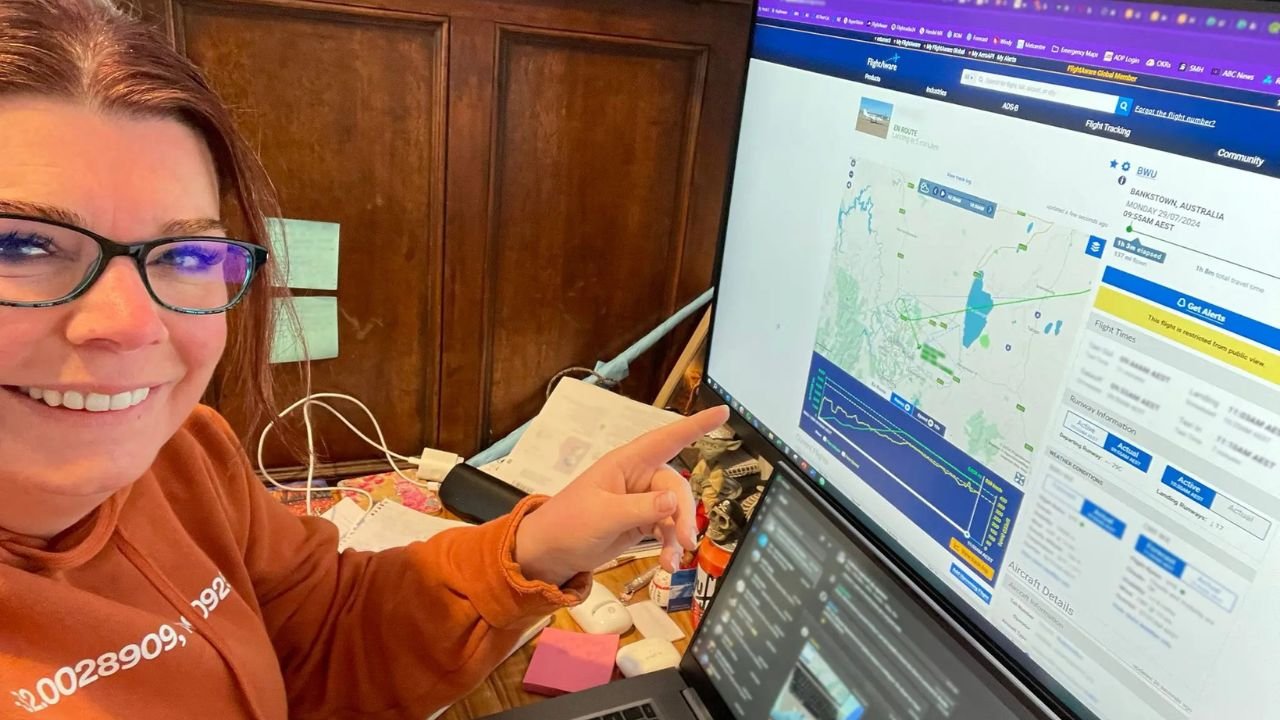
Yet for M’Shenda, data is never divorced from experience. “The human element is the beginning, centre and end of the entire data chain. While we can precisely quantify disaster impact and vulnerability, you can never forget the reality. The experience of fighting a fire gives me a glimpse into how fire behaves and how unpredictable it can be.
When combined with aerial imagery, historical data, and location intelligence that Nearmap offers, it allows us to build a solution that is practical and make an impact on the communities around us. Not to mention, having seen the faces of families who have lost everything or watched their house go up, you understand that this is real life and not just a data point.”
The challenges of merging tech and real-world disasters are significant. “The biggest challenges are timeliness and accessibility; the best data is useless if it can’t be actioned instantly. A common mistake is authorities relying on siloed datasets. Tech, especially location intelligence, solves this by ensuring everyone operates from a single source of truth, providing near real-time decision support. Our AI layers can show precise historical damage footprints for better pre-planning, greatly enhancing transparency and building resilience long before the disaster strikes.”
She cites the 2019–2020 bushfires as a pivotal moment. “We were able to capture the impact of the fires. More than 30,000 square kilometres of burnt areas – through detailed imagery. This offers us invaluable insights, allowing experts to look back, model, and learn about fire behaviour that had never been seen before, drastically informing future strategies.”
Looking forward, M’Shenda is optimistic about the role of technology in keeping communities safe. “The accessibility of emergency warnings and updates via apps like Hazards Near Me are invaluable. Preparation and communication are life savers. Any innovation that improves these two vital functions is what excites me most and what will keep communities safe.” If she could make one immediate change, it would be “a single data management platform that all agencies use, all based on the same real-time source of truth that allows true and instant collaboration.”
A vocal advocate for women in STEM, M’Shenda wants young women to understand that career paths aren’t linear. “A lesson from my life is that you don’t even need to start in STEM. I used my skills in finance and life experience to make the pivot in my career – do not underestimate what you know. STEM is fascinating, broad, rewarding, and vitally important to how we all live now and into the future. As disasters in Australia get more frequent and severe; we need all curious and active brains, and diverse experiences that we can get involved in order to build a resilient country for generations to come.”
Challenges in high-stakes fields haven’t deterred her. “I’m capable, strong, confident, and know a thing or two about the world around us. Self-confidence and awareness are key, so is not walking in with a chip on your shoulder. There are learning opportunities at every turn. Don’t jump to ‘they aren’t listening to me because I’m a female’ as your first instinct, is there another way to present your point of view? A different format or a style of conversation? Is a different time more appropriate?
This is an important life skill for any place where you are dealing with people. That’s not to say you won’t come up against it – find a mentor, talk to trusted colleagues, don’t let other people’s antiquated bias get in your way. This is your world, not theirs.”
Her resilience comes from perspective and humour. “My sense of humour gets me through; life doesn’t always need to be so serious. In the greater scheme of things, we are a collective bunch of atoms functioning in the most miraculous way. Appreciate life and the universe when you can. The one lesson from firefighting? Always look up. On the fireground, we must always look up to check danger from falling branches—that’s my life lesson.”
Outside of work, M’Shenda finds balance in simple joys. “I’m a proud fur mum of two cocker spaniels. They are an endless source of joy and love that neutralises any stress. A daily walk with them forces me to slow down – they sniff everything! My routine is a mix: morning yoga and strength training sessions throughout the week, which are massive for my mood and concentration.
I also train in Shaolin Kung Fu forms, which is great for brain and body. When I walk or commute, I switch off and let my mind wander. To my friends’ dismay, I have actually never listened to a podcast, but I do enjoy a familiar read. From re-reading Harry Potter and Hunger Games or spy action novels where I pretend I’d be cool, suave, and collected saving the world. In reality, I would be tripping over and getting lost – and I’m totally fine with that.”
Above all, M’Shenda is motivated by curiosity and impact. “We are living in an extraordinary time; the tools to make us more efficient and smarter are changing so fast that the motivation is almost served up without even looking. My drive comes from staying curious and engaged in everything I do. We only get one shot at this life, keep making a difference, and you’ve done well.”
For M’Shenda Turner, firefighting isn’t just a job, and tech isn’t just tools. Together, they are the frontier where courage meets innovation. And, where women in STEM are shaping safer, stronger communities for everyone.