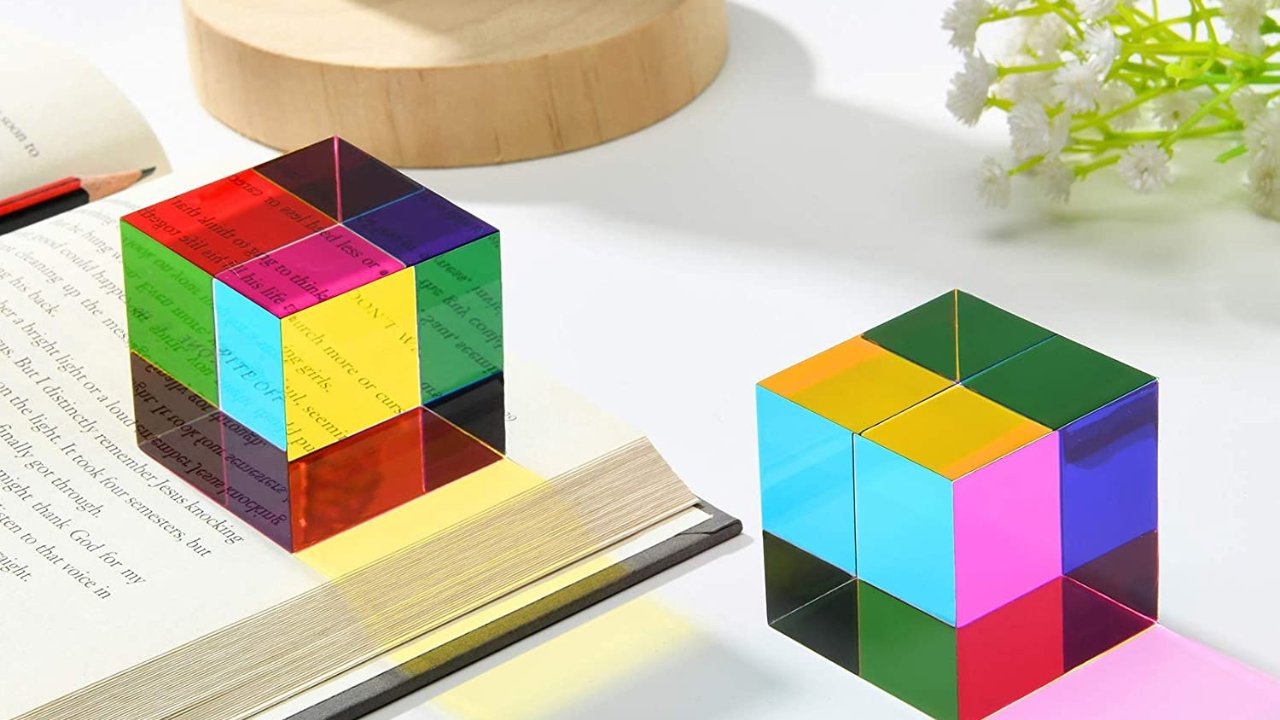
When Gabi Saper first asked her partner Enzo Gonzalez how colour theory and colour mixing actually worked, she probably wasn’t expecting the question to become the beginning of a global business.
But Gonzalez, true to form, didn’t simply spell it it.
“He did not just explain it, he went straight into the workshop and built me something to show me,” Saper recalls.
That handmade object became the first seed of CMY Cubes, the Sydney-born brand creating beautifully designed cubes, puzzles and sensory squishies that turn colour science and optics into hands-on play.
Five years later, that little experiment has become a business with more than 200,000 customers across almost 100 countries. CMY Cubes products now sit on the shelves of some of the world’s most prestigious cultural institutions, including the Museum of Contemporary Art Australia, MONA, Questacon and the Museum of Modern Art in New York.
And now, Saper and Gonzalez are preparing for their next chapter.
The Korean government has selected the two founders as one of just 40 companies worldwide for its flagship startup accelerator, run by the Ministry of SMEs and Startups, from thousands of applicants across more than 100 countries.
In September, the pair will head to Seoul to launch CMY Cubes into the Korean market.
For a two-person business that started at home in Sydney during the pandemic, it’s a pretty extraordinary trajectory.
It all started with a question
The origins of CMY Cubes are almost charmingly simple.
Saper was looking at an art installation at a museum online when she wondered aloud how colour theory and colour mixing actually worked.
Gonzalez’s response was to build something.
“That little handmade object, made purely so he could answer my question, was the very first seed of CMY Cubes,” Saper says.
The pair brought very different strengths to the idea. Gonzalez, an engineer, had always loved exploring light and physics, while Saper loved turning ideas into products people could love.
“The moment we knew it could be a business came a little later, when we showed early versions to other people and watched their faces,” she says. “Grown adults were as mesmerised as children. That instant delight told us we had something.”
They launched from home in 2020, in the middle of the pandemic.
There was no major investment, no large team and no corporate safety net.
There was, however, plenty of conviction.
“We launched from home in 2020, in the middle of the pandemic, with no money and a lot of conviction.”
That bootstrapped approach has remained central to the business. What began as a two-person operation has grown to a team of five, but Saper and Gonzalez still own the company outright.
Building a business without a safety net
For all the glossy milestones – international customers, museum shelves and now a launch into Korea – building CMY Cubes hasn’t exactly been a smooth ride.
“The hardest part is that there is no safety net,” Saper says.
“Every decision, every risk, every late night is yours, and when something goes wrong, and plenty has, there is no department to hand it to.”
And things have gone wrong.
At one point, a major shipping partner collapsed, wiping out most of the company’s revenue almost overnight. Later, tariffs forced the founders to renegotiate their entire supply chain within weeks.
For a bootstrapped business, those aren’t minor bumps in the road.
“Each time, it was just us, solving it in real time.”
The founders have also had to contend with the particular challenge of growing a successful physical-product business without external funding.
“Bootstrapping also means growth is always bumping up against cash; you can only grow as fast as you can fund it.”
Yet Saper sees an upside to having built the business this way.
“It has kept us incredibly close to our customers and our numbers, and everything we have built, we genuinely own. There is real pride in that.”
The moment it became bigger than an idea
The first major indication that CMY Cubes could become something much bigger came surprisingly early.
The company passed seven figures in its first year.
“That was the moment we sat up and realised this was not just a nice idea, it had genuine momentum.”
Since then, the momentum hasn’t stopped.
Orders now arrive from almost 100 countries, while CMY Cubes products have found their way into some of the world’s most respected museums and cultural institutions.
Still, Saper says they continue to think of themselves as a startup.
“We definitely still see ourselves as a startup.”
Perhaps that’s because the founders haven’t lost sight of the slightly surreal origins of the business.
“It is a strange and wonderful thing to build something at your kitchen table and watch it reach people all over the world.”
A toy that isn’t really just a toy
Part of CMY Cubes’ appeal comes from the fact that it doesn’t fit neatly into one category.
It’s part toy, part design object, part science lesson and part sensory experience.
And that was deliberate.
“When we started, toys and design objects lived in completely separate worlds,” Saper explains. “Educational toys were often functional but not beautiful, beautiful design objects were rarely educational, and almost none of it was grounded in real science.”
The founders saw an opportunity in the gap between those worlds.
“We saw a space in the middle that nobody was filling: an object genuinely rooted in physics and colour theory, gorgeous enough to sit on a shelf as art, and so satisfying to hold that it could actually pull someone away from a screen.”
Importantly, they never wanted CMY Cubes to be restricted to children.
“We never believed wonder belonged only to children.”
It has become one of the brand’s biggest strengths. Children love the products, and so do adults – Saper and Gonzalez discovered that early on when they watched grown-ups react to their prototypes.
“We were not just making a toy. We were making a small piece of magic that happens to be real science.”
Why screen-free play matters now
The company’s philosophy feels particularly relevant at a time when screens have become embedded in almost every part of daily life.
Children now spend around five and a half hours a day on screens, according to the founders, and CMY Cubes offers a deliberately tactile alternative.
The products are built around real science and hands-on discovery, with the range STEAM accredited and registered under Australia’s NDIS as a sensory aid.
But Saper is quick to point out that the company’s philosophy isn’t anti-technology.
“We are not anti-technology, we run a global business on it, but we have become real believers in balance, and in the particular focus and calm that come from holding a physical object and turning it over in your hands.”
Building CMY has also changed the way Saper and Gonzalez think about play themselves.
“We think about play as something serious now, as one of the most important ways people of any age learn and reset.”
And then there’s the emotional side of it.
“And it has made us protective of wonder, of that moment when someone’s face lights up at something they do not quite understand yet.”
“That feeling is really what we are in the business of protecting.”
The next big move: Korea
Now, that sense of curiosity is taking CMY Cubes to a new market.
Korea is a particularly exciting opportunity for the brand, with strong interest in design, educational products and adult toys. Adult toy spending in the country reportedly jumped more than 200 per cent in a single year, making it an intriguing market for a brand that has always blurred the boundaries between toy, art object and educational experience.
But for Saper, being selected for the Korean accelerator is about more than commercial potential.
“The business case for Korea is strong, it is one of the most exciting markets in the world for the design-led, educational play we make.”
The personal significance, however, is even greater.
“Thousands of companies enter, and when we applied we did not really think much of our chances.”
“So to actually be picked makes us feel like we are genuinely onto something.”
The selection represents something of a full-circle moment for a business that began with one homemade object and no investment.
“It is a huge validation of what we have been building, quietly, from home, for five years, and it makes us so excited for what comes next.”
And perhaps most importantly, it confirms that the founders’ instinct to back their unusual idea was the right one.
“We built this from nothing, with no investment, so to be chosen from thousands of companies around the world, by a foreign government, as worth backing, means an enormous amount.”
“It is the kind of thing you dream about quietly and never quite believe will happen to you.”
What entrepreneurship has taught her
Ask Saper what she would tell herself on day one and the answer is remarkably simple: trust yourself sooner.
“I would tell us to back ourselves sooner and harder.”
In those early days, there was plenty of uncertainty.
“We were cautious, second-guessing whether people would really want this, whether we were even allowed to call ourselves a real business.”
With hindsight, she’d tell her younger self to move faster.
“If I could go back, I would say the instinct is right, trust it, and move faster.”
She’d also offer a different perspective on the inevitable disasters that come with building a company.
“Every disaster we were terrified of at the time, the shipping collapse, the tariffs, became the thing that made us stronger and taught us the most.”
Perhaps the most important lesson, though, is to actually stop and appreciate the journey.
“When you are building something, it is easy to only ever stare at the next problem.”
Her advice?
“I would tell us to look up now and then and take in how extraordinary it is that people all over the world are holding something we dreamed up at home.”
Resilience, purpose and building together
After five years of running a global company, Saper says the biggest surprise has been discovering just how resilient they could be.
“That we are far more resilient than we ever realised.”
She describes entrepreneurship as a particularly revealing experience when there’s no large company behind you to absorb the pressure.
“I do not think you truly find out what you are made of until everything is on the line and it is entirely on you, with no big company to fall back on.”
The shipping collapse, in particular, tested them.
“We have learned that we can be knocked down hard, lose most of our revenue overnight, face problems we have no idea how to solve, and still get up and work it out, every single time.”
But perhaps the most meaningful lesson has been that building a successful business isn’t just about selling something people want.
“It has also taught me how much I need to be building something with meaning, not just something that sells, but something that puts a little wonder and calm into people’s lives.”
And then there’s the fact that she gets to build it alongside her partner.
“Doing it beside my partner has taught us how to be a genuine team, to trust each other’s instincts, cover each other’s weak spots, and hold each other up on the hard days.”
“I honestly do not think any other path would have taught us those things quite so vividly, or so fast.”

From one handmade experiment in a workshop to museum shelves around the world, CMY Cubes is a reminder that some of the strongest businesses don’t necessarily begin with a giant business plan or a room full of investors.
Sometimes they begin with a question.
Sometimes they begin with making something just to show someone you love how the world works.
And sometimes, if you’re willing to back that idea, keep going when things get hard and protect the original sense of wonder that made it special, they can take you much further than you ever imagined.