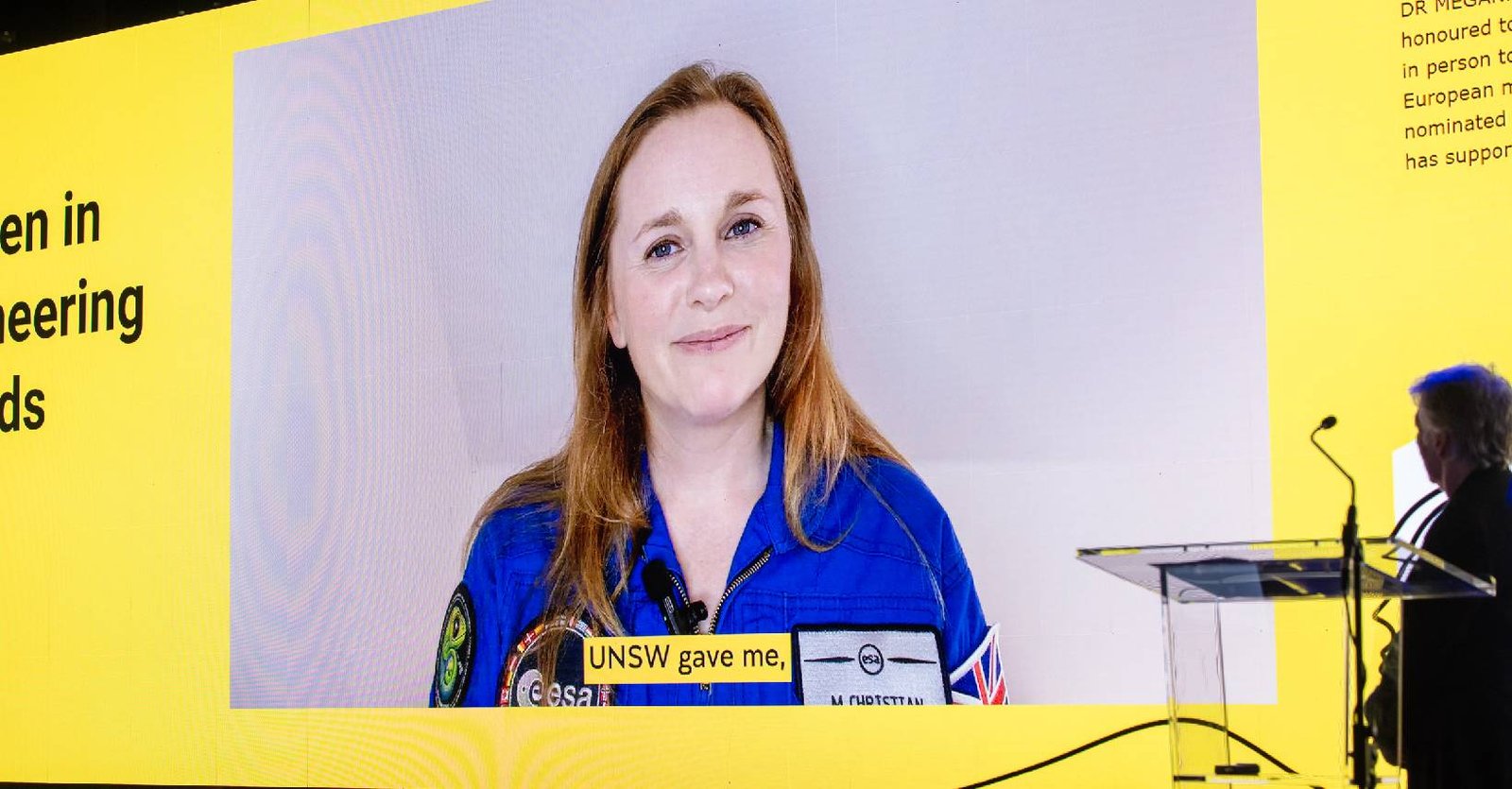
Dr Meganne Christian’s incredible journey from testing graphene for satellites and surviving an Antarctic winter to joining the European Space Agency astronaut reserve.
You don’t just apply for a job as an astronaut straight out of university. For Dr Meganne Christian, the journey to the European Space Agency (ESA) involved testing materials in zero gravity, braving the isolating extremes of Antarctica, and learning vital life skills in university revues.
Recently honoured with the Judy Raper Award for Leadership at the 2026 UNSW Women in Engineering Alumni Awards, Meganne’s story is a reminder that the path to groundbreaking success is rarely straightforward and that staying relentlessly curious is an engineer’s greatest asset.
From the Lab to the Ends of the Earth
Meganne’s career is a masterclass in embracing the unexpected. From 2014 to 2023, she worked as a materials science researcher at the National Research Council of Italy. Her work wasn’t confined to a traditional lab; she participated in parabolic flight campaigns, often dubbed “vomit comets”, to test graphene coatings for thermal management in satellites.
But her pursuit of science didn’t stop in the skies. Meganne undertook two gruelling missions to Concordia Station in Antarctica, including a “winter-over,” where she served as a research scientist in charge of atmospheric physics and meteorology in one of the most remote and extreme environments on Earth.
Beating the Odds: 1 in 22,500
Those diverse, high-stakes experiences culminated in a historic selection. In November 2022, Dr Christian was chosen from a staggering pool of over 22,500 applicants across Europe to become one of the 17 members of the ESA’s first astronaut class in 13 years.
Today, she serves as a member of the ESA astronaut reserve and the Senior Exploration Manager (Commercial) at the UK Space Agency, advising on the future of human and robotic spaceflight in the post-International Space Station landscape.
The Secret to Reaching Orbit? Say Yes to Everything
While her resume is out of this world, Meganne credits her foundational years at UNSW for giving her the ultimate launchpad. Unable to collect the award in person, her sister Delyse accepted it on her behalf, while she shared a video message that serves as essential advice for the next generation of women in STEM.
“When I think about what UNSW gave me – it wasn’t just an Engineering degree and a PhD.
It shaped me into not only a researcher, but a well-rounded person through the incredible range of student activities like Engineering Ambassadors and Revues, leadership opportunities like the Co-Op program and Yellow Shirts, and through my friendships.”
She highlighted that the interpersonal and leadership skills learned outside the classroom became the unexpected springboard for her career.
“One of the biggest lessons I have learnt is that careers rarely follow a straight line. The opportunities that have had the greatest impact on my life are ones I could never have predicted as a student.
What matters is staying curious, saying yes to new challenges and being willing to grow in directions you never imagined.”
Why Her Story Matters for Women in STEM
The UNSW Women in Engineering Alumni Awards celebrate women who are creating impact and serving as role models. Professor Rita Henderson, Deputy Dean at UNSW’s Faculty of Engineering, noted that awards like these are “a way of making excellence visible and showing what becomes possible when talent is supported, included and celebrated.”
For young women looking at Meganne’s trajectory, the takeaway isn’t that you have to be perfect from day one. It’s that you have to be open to exploration.
Dr Meganne Christian’s Top 3 Lessons for Future Innovators:
- Embrace the Non-Linear: Don’t stress if your career path zigzags. Often, the detours lead to the most extraordinary destinations.
- Get Involved Beyond the Classroom: Technical brilliance is essential, but well-rounded leadership, communication, and community skills are what elevate a career.
- Dream Big and Explore Widely: As Meganne puts it, “find a path that is meaningful to you” by being willing to grow in directions you never initially imagined.

Dr Gunilla Burrowes (right) receives her Ada Lovelace Medal from 2025 winner Rebecca Cook