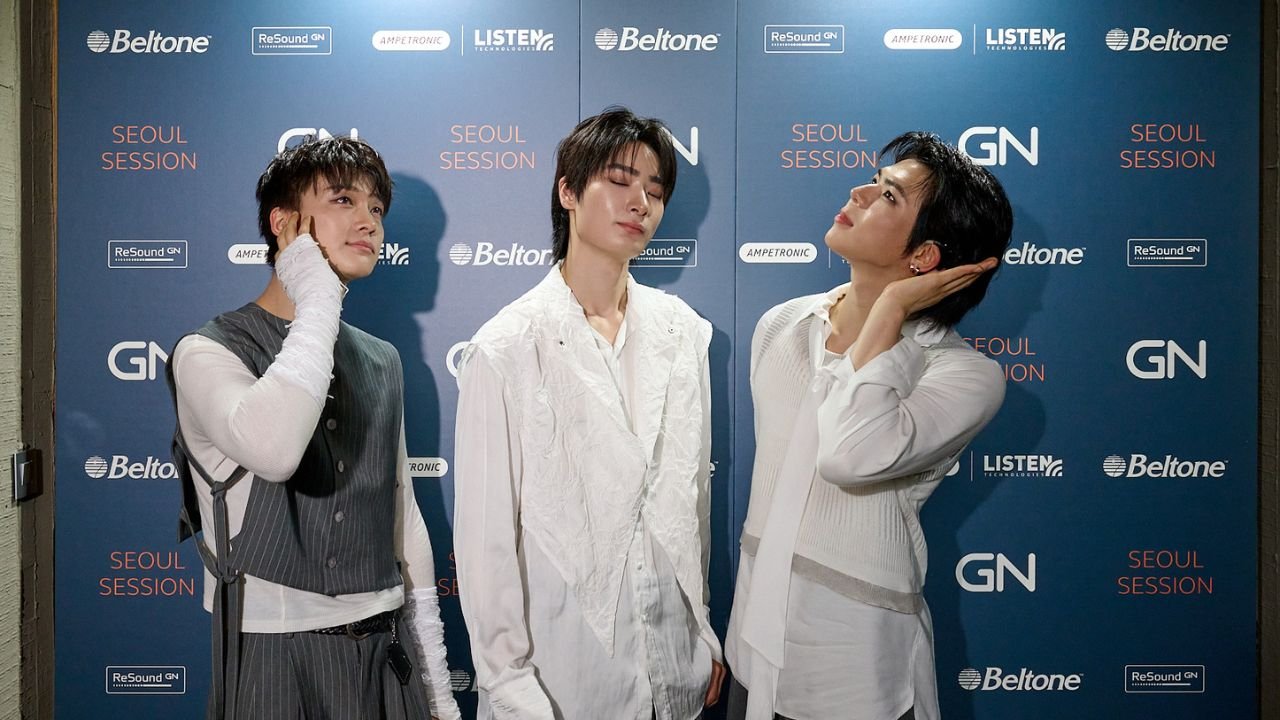
One thing I quickly learned upon my arrival in South Korea is that its capital, Seoul, welcomes you with an aesthetic overload. Neon reflections bounce off glass buildings, beauty ads promise glass skin by breakfast, and K-pop plays somewhere in the distance like it’s as much a part of the city’s bloodstream as kimchi.
So when I ended up at “Seoul Session: A Live Auracast Event” featuring a vibrant performance by Big Ocean, the world’s first hard-of-hearing K-pop group, it already felt like I had stepped into a version of culture where everything – music, tech, accessibility, identity – has the volume turned up.
And then I experienced something I didn’t expect to think about at as a I bopped along: Auracast. Not as a futuristic, kind of hard-to-decipher concept in a press release. But as a real-deal tech development I could actually use.

When K-Pop Meets Next-Gen Bluetooth (and it actually makes sense)
Great skin. Check. Floppy hair. Check. Excellent dance moves. Check. Check. And, check.
At first glance, Big Ocean looks like a rising K-pop group. However, unlike BTS, BlackPink and SajaBoy (my three year old nephews personal fave), members Kim Ji-seok, PJ, and Lee Chan-yeon aren’t just out here slinging catchy hits. Alongside building a devoted following through a combination of singing, dancing, and Korean Sign Language (KSL), that has earned them a place on the Forbes 30 Under 30 Asia list, they’re also part of a shift in what performance can look like when accessibility isn’t an afterthought.
Their Seoul showcase – part concert, part tech demonstration hosted by GN Group – a global leader in hearing, audio, video and gaming solutions – in collaboration with Ampetronic – a world leader in the design and manufacture of audio induction loop systems during the World Congress of Audiology – was designed around a simple but radical idea. That everyone should hear the same moment, in the same quality, at the same time.
That’s where Auracast came in.
Auracast is a Bluetooth capability that lets venues broadcast sound directly to compatible personal devices, so people can listen on their own hearing aids, earbuds, or smartphones through supported apps (such as on select Google Pixel and Samsung devices).
Instead of relying on fixed seating zones or borrowed receivers, it creates a more flexible and inclusive listening experience by allowing users to connect straight to the venue’s audio stream.
In practice, the system works through an Auri Transmitter, which sends out the venue’s live audio feed, and Auri Receivers, which pick up that broadcast so individuals can tune in and hear the performance clearly and consistently in real time.
If traditional Bluetooth feels like pairing your phone to a single speaker in a messy, slightly stressful digital handshake, Auracast is the opposite energy entirely. It doesn’t “pair” devices one by one. Instead, it broadcasts audio like a public signal – more like joining a Wi-Fi network than syncing headphones.
Think: one transmitter in the venue sending out sound. And anyone nearby with compatible earbuds, headphones, or hearing aids can simply tune in. No awkward pairing. Nor “can you hear it now?” panic. Just… sound, available.
It feels less like tech and more like switching channels in real life
In Seoul, the Auracast setup meant the venue was essentially streaming the live performance as a dedicated audio channel.
I opened my phone, scanned what looked like a simple broadcast option, and suddenly I wasn’t relying on the room acoustics, crowd noise, or where I happened to be standing. I was connected directly to the performance audio – clean, consistent, and weirdly intimate for something happening in a packed live space.
Within the same room, people were listening in different ways but sharing the same experience. A deaf person, a hard-of-hearing person, and a hearing person could all sit side-by-side, engaging with the performance through whatever combination of technology worked best for them. The technology wasn’t separating audiences into different categories. It was bringing everyone into the same moment. And, as we collectively tucked into a quintessential Korean dinner of fried chicken and beer, I can confirm it all felt surprisingly natural.
Big Ocean, and the quiet power of shared sound
What made the experience land emotionally wasn’t just the tech – it was who it was built around.
Big Ocean are the first K-pop group made up of members who are hard of hearing. Their existence already challenges the assumption that music is only for people who experience sound in one “standard” way.
At this event, that idea wasn’t theoretical.
Auracast allowed the performance to be delivered as a shared, synchronised audio experience, designed so that audience members – including those with hearing loss – could access high-quality sound directly through their own devices.
No separation. No “special section.” And no visible divide in the audience experience. Just one room, one stage, one stream of sound.
It reframed something really fundamental about live music: maybe accessibility isn’t about adding extra systems on top. Maybe it’s about making the main system more flexible in the first place.
It was also a reflection of research conducted by YouGov, across Australia, the UK and the US – which reveals that over a third of people with hearing loss report being perceived as rude or disengaged, and up to 40% say they are seen as less intelligent or less capable. Additionally, more than a third say others believe they should be able to “try harder” to hear.
Andreas Anderhov, GN APAC President said “These misconceptions don’t just affect perception, they influence how environments are designed, often overlooking the complexity of hearing in dynamic, noisy settings. That’s why our focus at the World Congress of Audiology is to create an experience that everyone can participate in fully and equally.”

So what is Auracast really doing? (In non-tech-people terms)
Strip away the industry language, and Auracast is basically this:
It turns any public audio source into something closer to a broadcast you can join. Not a device you have to attach yourself to.
So instead of:
- pairing headphones to a single phone
- relying on venue speakers
- or needing special assistive devices issued at the door
You just:
- open your settings
- find the available audio stream
- tap to join
It works for concerts, airports, gyms, museums – anywhere sound matters but clarity usually doesn’t scale well. It’s like public Wi-Fi, but for audio. Except instead of scrolling Instagram, you’re hearing the same moment as everyone else in the room.
Why this hit differently in Seoul
There’s something about experiencing this technology in Seoul – a city already so deeply intertwined with global pop culture and cutting-edge consumer tech – that makes it feel less like “future innovation” and more like “this is already becoming normal.”
And paired with Big Ocean’s performance, it didn’t feel like a demo. It felt like a proof point. Not just that Auracast works, but that shared cultural experiences don’t have to be built around a single way of hearing anymore.
The bigger shift hiding underneath all of this
We tend to think of audio tech as incremental: better headphones, better noise cancellation, slightly smarter earbuds.
But Auracast feels like something else entirely. It moves sound from being point-to-point (your device, your connection, your experience) to many-to-many (a shared broadcast that anyone can access on their own terms).
And when you see that applied to a K-pop performance by a group like Big Ocean, it stops being abstract innovation and becomes something much simpler:
More people, hearing the same moment, without barriers, deciding who gets to participate properly. If K-beauty is about skin that looks effortlessly real, and K-pop is about performance that feels impossibly polished, then Auracast is quietly doing something similar for sound.
It’s making audio feel… seamless.
Not louder. Not more complicated. Just more available.
And honestly, after Seoul, going back to “normal” Bluetooth feels a bit like using an abrasive apricot-scrub in a world that has already embraced PDRN!