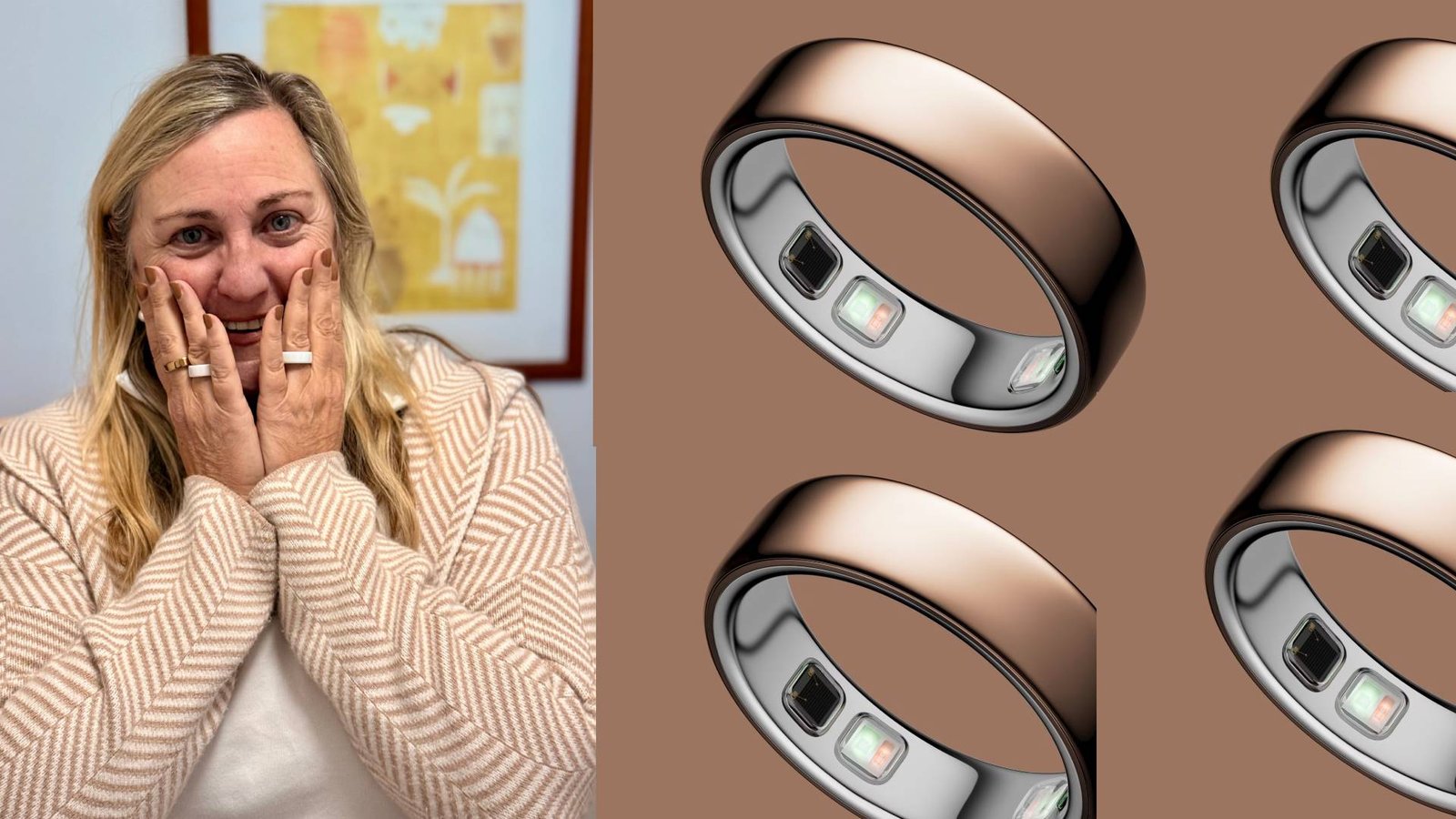
The first thing I noticed wasn’t what the Oura Ring 5 does. It’s what it doesn’t do: announce itself. Slipping it on for the first time, I had to glance down to check it was actually there.
I’ll admit my bias upfront — I’m an Oura enthusiast. I’ve written about these rings before, loved the Oura Ring 4, and now I’m enjoying its slimmer successor. But even I wasn’t prepared for just how much smaller this generation is. The Oura Ring 5, which began shipping in Australia in June, is a full 40 per cent smaller than the Ring 4, making it the world’s smallest smart ring. Crafted from lightweight, non-allergenic titanium with a smoother curvature, it looks and feels like any other piece of jewellery.
“Oura Ring 5 is the most significant leap in smart ring history,” says Holly Shelton, Oura’s chief product officer, who explains the company had to rethink every assumption — the sensors, the battery, the architecture, the very geometry of the ring — to shrink it by 40 per cent without sacrificing accuracy.
The science behind that accuracy is fascinating. Oura has long argued the finger is the optimal place to measure health signals: the arteries there give optical sensors a pulse signal up to 100 times stronger than at the wrist. The Ring 5 builds on that advantage with re-engineered sensing — low-profile sensor domes for better skin contact, more powerful LEDs, and twelve stronger signal pathways delivering greater accuracy across more finger types and skin tones.
It’s also built for real life: Oura’s most scratch-resistant ring yet thanks to a new extra-strong coating, dust-proof and waterproof to 100 metres, available in sizes 6 to 13 across six finishes — including a redesigned, truer Gold and the one I wear – the new Deep Rose, a rich copper-rose which I predict will be everywhere by spring.

Finally, A Wearable That Takes Women’s Health Seriously
Here’s where the Oura Ring 5 story becomes so positive for women’s health: the software launching alongside it puts women’s health front and centre.
The headline act is Menopause Insights, built around Oura’s new Menopause Impact Scale — a proprietary, research-driven clinical questionnaire that replaces a decades-old legacy tool developed from a small, clinic-based sample. It asks structured questions across sleep, mood, cognition and daily functioning, then translates your answers into a personalised dashboard showing how strongly perimenopause is affecting your daily life. You can track those patterns over time, see how lifestyle changes and stress relate to shifts in your symptoms, and share your results directly with your doctor for more informed conversations about treatment.
Then there’s Hormonal Birth Control, a first-of-its-kind adaptation of Cycle Insights for women using pills, patches, IUDs, implants and other hormonal methods. It offers a window into how contraception may influence your unique baseline — connecting what you’re feeling to what’s actually happening inside your body across hormone and hormone-free days.
Rounding it out is Lab Uploads, which arrived in June, lets you import blood work results directly into the Oura App so your clinical biomarkers sit alongside your daily biometric data. For anyone who has ever tried to piece together their health story from a filing cabinet of pathology results, this is such a step ahead.
It’s Your Brain, Not Your Willpower
There’s also support for those of us who set our health goals in January and abandon them by February. Yep, that’s failingly and unfailingly me.
The company’s latest research dive explores how the brain’s reward system — dopamine, the default mode network and the prefrontal cortex — shapes our ability to stick with healthy habits. Motivation isn’t a moral quality you either have or lack; it’s a system you can work with, and Oura offers five science-backed strategies to do exactly that.
Stress, Measured Over The Long Haul
The feature I’ve found most compelling is Cumulative Stress, released in November 2025 and developed with academic research partners. Where most wearables give you a snapshot of today’s stress, Cumulative Stress tracks the longer-term toll on your body over a rolling 31-day window.
That distinction matters. One frantic day won’t undo you. A frantic month, quietly compounding, is another story and this is precisely the kind of pattern we are least likely to notice in ourselves.
Being on Oura’s newsletter list, I also receive useful advice. For instance, Oura adviser and stress expert Elissa Epel, one of the world’s leading researchers on stress and ageing, offers practical guidance for anyone whose score is creeping in the wrong direction:
- Review the factors actually contributing to your stress score, rather than guessing
- Keep up regular physical activity — but build in genuine recovery
- Take short breaks throughout the day
- Spend more time on things you actually enjoy
- Reflect honestly on which sources of stress you could change or reduce
Simple advice, yes. But paired with a month of your own physiological data, it lands very differently.
The Health Check You Didn’t Know You Needed
Oura is currently recruiting eligible members for its Blood Pressure Profile Study, investigating what researchers call “hidden hypertension” — high blood pressure that goes undetected because so many of us only ever have it checked at the occasional GP visit, if at all. The question at the heart of the study is a can a ring on your finger help identify cardiovascular risk without cuffs or clinic appointments?
And sometimes, paying attention to the data saves lives. Oura member Kim R. noticed her metrics shifting — an elevated resting heart rate, rising daytime stress — and, prompted by the changes, sought medical attention. She was diagnosed with a serious heart condition and received treatment. The ring didn’t diagnose her; her doctors did (Oura is clear it’s not a medical device). But it was the ring that told her something was worth investigating.
The Everyday Extras
The quality-of-life upgrades matter too. Battery life now stretches six to nine days, and the new aluminium Charging Case stores a month of charge and supports wireless charging, a travel essential. Live Activity Tracking lets you start a workout in the app and follow pace, distance and heart rate in real time, with lock screen widgets for running, cycling and strength training, while improved Automatic Activity Detection now picks up low-motion workouts like Pilates more accurately than ever. A new Locate feature helps you find a misplaced ring or case, and a time-based Data Deletion tool gives you granular control over your stored data — worth noting that Oura’s membership model means it doesn’t sell your data, full stop.
The Verdict
The Oura Ring 5 is available now from ouraring.com, JB Hi-Fi, Harvey Norman and Amazon, priced at AUD $649 for Silver and Black, and $799 for premium finishes — Gold, Stealth, Brushed Silver and Deep Rose. Membership is $9.99 a month or $109.99 a year. One tip from experience: order the new Ring 5 sizing kit even if you own an earlier Oura — at 40 per cent smaller, the fit is different at the same size.