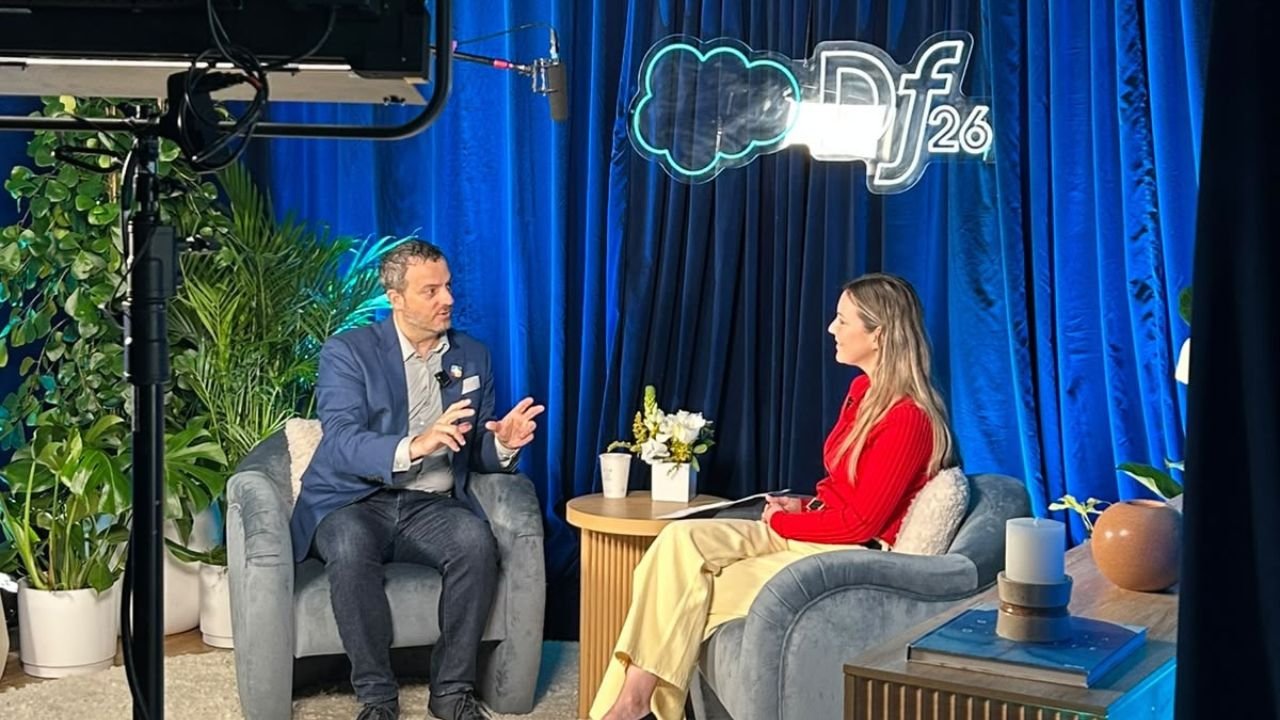
Podcaster Georgie Healy was the only Australian podcaster invited by Salesforce to attend Dreamforce in San Francisco. Here’s what the AI leaders said, what they agreed on, and what it means for Australian businesses.
Men At Work’s Land Down Under was playing as 10,000 people filed into the Day 1 keynote in San Francisco. It’s nice to see Australia still represented despite the AI ‘Goldrush’ in San Francisco.
Salesforce flagship event ‘Dreamforce’ is basically three days of Christmas for people in tech. This year the CEO Marc Benioff shared the stage with the top 3 AI leaders in the world: Anthropic’s Dario Amodei, NVIDIA’s Jensen Huang and OpenAI’s Sam Altman. Even media veterans with a dozen Dreamforces under their belt kept saying the same thing: it’s wild to have these people in one room.
Here’s what I brought home.

1. The SaaSpocalypse is cancelled (for now)
For six months the market narrative has been that AI agents will kill traditional software. Benioff called it “crazy nonsense” and reframed it: it’s not the end of software, it’s the end of software that makes humans do all the work.
His argument is that AI models on their own will keep failing inside big companies because they are probabilistic and not grounded in a single source of truth. He told a story about a mate who built a beautiful app on ‘Claude’, and every time he demos it, the number is wrong.
My take: The 3 most important people in AI don’t turn up on the Salesforce stage as a favour, they came because they believe they need the partnership too
2. Pace it or race it?
The most interesting tension of the week was between two men who agree on safety matters and disagree on almost everything else.
Dario Amodei, the Anthropic CEO whose essay on ‘pacing the frontier’ landed days before the event, laid out a three-step plan: get your own house in order, organise the industry on standards, then take it international. But NVIDIA (The chip giant)’s CEO Jensen Huang wants to race. He agreed safety comes first but defined it as an engineering problem: build the test environment, test the product, and if you’re not confident, don’t ship it. “We don’t need any new laws,” he said.
Sam Altman sat somewhere in between. He called a recent security incident involving Hugging Face “terrifying” and “a real wake up call”, and argued AI needs the culture aviation has, where every accident is reported and investigated in the open.
Australia has already shown which way it leans on tech harms. We banned under-16s from social media. That debate is coming for AI too.
3. Big business just got fast
This was my biggest surprise. The gap between nimble startups and big enterprise is far smaller than I expected.
Years ago at Accenture, I worked on a six-month Salesforce rollout at a major Australian media company. Most of those six months weren’t the tech. They were custom builds, integrations, training and change management.
At Dreamforce, I met Formula 1’s team behind Marshall, a new AI agent that talks directly to fans. Picture two fans. One (me) wants merch. The other wants to understand the latest regulation changes. Marshall serves both differently. It was set to launch within weeks, and F1’s head of customer told me he’s learning while doing.
Closer to home, Fisher & Paykel and Xero are both rolling out Claudeforce, the new Salesforce and Anthropic partnership. In plain English: the world’s biggest CRM and one of the most capable AI models just kissed. Teams build agents by describing what they want, the agents sit on workflows the company already has, and it’s “headless”, so you never log into Salesforce. You ask Claude, and your data comes to you.
The catch: learning while doing also means learning in front of your customers. I’ll be watching which rollouts still look good in six months.
4. Nobody is using AI properly yet
The one thing every leader agreed on? We’re barely scratching the surface. Dario reckons that even if the frontier froze today, we’re capturing maybe five to ten per cent of the available value. Benioff spent two months in Europe and didn’t see a single autonomous vehicle.
Roland Busch put it best for anyone in a real-world industry. Siemens technology runs one in every three manufacturing lines on the planet, and his line was blunt: “hallucination does not really work on the shop floor.” His fix is context, pulling product data, service history and a network of 120,000 suppliers into one place.
5. The best stories were about agents getting it wrong
My favourite interview of the week was with Joe Inzerillo, Salesforce’s President of Enterprise and AI Technology, for In the Blink of AI. Salesforce tests everything on itself before customers see it, and he shared how one of their own agents, given an overly broad rule, refused to sell Salesforce’s own product. Another agent that routes legal requests cut wait times from two weeks to two days.
That’s the honest picture. The wins are real, and so are the face-palm moments. The companies getting ahead are the ones prepared to have both.
The most important take away
There has never been a better time to be non-technical.
If you’re reading this thinking, “this sounds complicated” or “AI isn’t for me”, well I have great news. AI is lowering the technical barrier. You can now use plain English to build a product, create a website, analyse information or get to an answer without needing to know how to code.
I want to see more non-technical people using AI to reduce the admin, busywork and friction in their lives. I’m so passionate about supporting women and non-technical people that I left Google to share what I’m learning through this newsletter and podcast every week. If you tried AI six months ago and it didn’t click? Try again. It’s getting easier, ridiculously fast.
The full behind-the-scenes, from celebrities to press-room moments, is on my Substack, Attention Is All I Need, and my Dreamforce interviews are rolling out on In the Blink of AI now

Disclosure: Salesforce covered Georgie’s travel to Dreamforce, but this is not authored by them, this is Georgie’s-own words and opinions