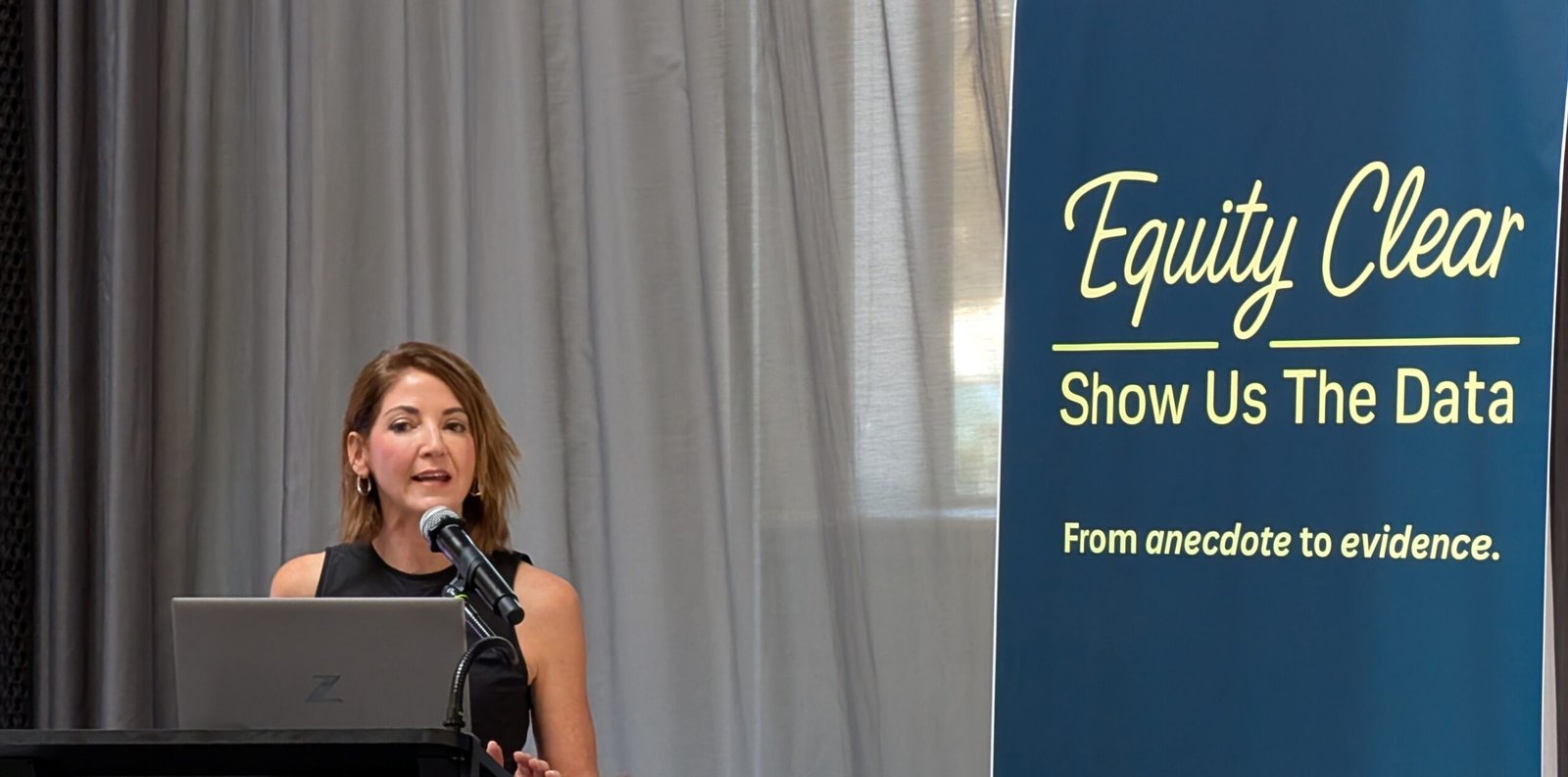
On a cool Sydney evening this week, more than 150 of Australia’s most influential venture capital firms, start-up accelerators and innovation leaders gathered at Stone & Chalk for what may become a pivotal moment in Australia’s innovation ecosystem.
It was the unveiling of Australia’s first National Reporting Standard for investor pipeline diversity, an initiative designed to answer a question that has frustrated policymakers, investors and founders for more than a decade:
Why do women founders receive only two per cent of venture capital funding in Australia? For Equity Clear founder Noga Edelstein, the answer wasn’t what she expected.
“The more I dug into it, the more I realised the real problem wasn’t the two per cent,” she says. “The real problem was that nobody had the data to explain how that outcome came about.”
Looking Beyond the Statistic
Edelstein’s journey began with her own experience as a founder.
After starting her career as a corporate lawyer and later serving as General Counsel at Yahoo!7, she launched and scaled a household services marketplace, raising venture capital before successfully exiting the business in 2018. But the fundraising process left a lasting impression.
“Raising capital was one of the most difficult and soul-destroying experiences of my life,” she says.
Determined to help other women founders, Edelstein became deeply involved in Australia’s startup ecosystem, supporting female entrepreneurs through mentoring and accelerator programs. Yet despite growing awareness, new initiatives and countless conversations, the numbers barely shifted.
“We were helping individual founders, but we weren’t shifting the metric.”
So, she began looking for answers in the data. What she found was surprising. There was no data. Or more accurately, there was no way to understand what was happening between a founder’s first approach to an investor and the final funding decision.

The Industry’s Blind Spot
According to Noga, Australia’s venture capital ecosystem suffers from a critical blind spot. The industry measures outcomes increasingly well. Investors track valuations, growth rates, returns and risk with extraordinary precision. Yet when it comes to understanding how opportunities move through the investment process, visibility disappears.
“We only measure the final outcome,” Noga explains. “We don’t know who applied, who got a first meeting, who progressed to due diligence, who made it to the investment committee, or where founders are falling out of the process.”
Without that information, investors, policymakers and ecosystem leaders are left guessing.
“We’ve spent years trying to solve a problem we couldn’t properly diagnose.”
That insight became the foundation of Equity Clear’s Show us the Data initiative.
More Than a Gender Issue
While the conversation is often framed around gender equity, Noga believes the implications are much broader. Australia’s productivity growth has remained largely flat for more than a decade, while governments and industry leaders increasingly point to innovation and entrepreneurship as critical drivers of future economic growth. Yet almost all venture funding continues to flow to all-male founding teams.
“What we’re really talking about is leaving opportunity on the table,” she says.
Research from the Boston Consulting Group and the Cherie Blair Foundation estimates that fully unlocking women-led innovation could create up to $135 billion in economic value for Australia.
But it’s not just about economics. Women founders are often building businesses in areas such as healthcare, climate, education and community wellbeing, sectors that directly affect how people live and work.
“When those innovations don’t get funded, we’re not just losing businesses. We’re losing solutions to some of society’s biggest challenges.”
Building the Missing Infrastructure
The breakthrough came after Equity Clear consulted with more than 160 organisations across venture capital, government and the startup sector. The research revealed that 92 per cent of venture capital firms were already collecting gender data. The problem wasn’t a lack of information. The problem was that everyone was collecting it differently. Different definitions. Different reporting systems. Different measurement points. Even something as simple as defining a “woman-led company” varied between organisations.
As a result, the information couldn’t be meaningfully compared or analysed at an industry level.
“We had plenty of data,” Noga says. “It just wasn’t useful.”
The solution became Australia’s first National Reporting Standard for investor pipeline diversity, a common framework that allows investors to measure the same things, in the same way, at the same points in the funding journey. For the first time, the sector will be able to see how opportunities move through the pipeline, from first meeting to funding decision.
From Anecdote to Evidence
The initiative is already attracting significant support. Before the official launch, Equity Clear had exceeded its target of 20 pilot participants. The inaugural cohort includes Blackbird, Airtree, Main Sequence, Startmate, Cicada Innovations, Side Stage Ventures, Black Nova, Aussie Angels and a range of other influential ecosystem organisations. Importantly, the reporting will be aggregated and anonymised. The goal isn’t public naming and shaming. It’s building evidence.
“The goal isn’t data for the sake of data,” Edelstein says. “The goal is understanding what actually works.”
Lessons from the United Kingdom’s Investing in its Women Code initiative highlights the potential impact.
Five years of reporting has revealed patterns that were previously invisible. For example, investors overwhelmingly favour warm referrals, while women founders are more likely to approach investors through cold outreach. That insight immediately changes the conversation. Instead of debating assumptions, investors can identify specific points in the system where opportunities are being lost and design interventions that address them.
“For years we’ve been looking at the scoreboard without being able to see the game,” she says. “What we’re building is the evidence needed to understand what’s actually happening beneath the headline statistics.”
A Vision for the Future
While gender is the starting point, Edelstein sees a much bigger opportunity ahead.
Over time, Equity Clear hopes to expand reporting to include other dimensions of diversity, including First Nations status, cultural and linguistic background and disability. More importantly, she wants to transform how the ecosystem thinks about data itself. Historically, data has been used to explain the past. Equity Clear aims to use it as living intelligence, helping investors, policymakers, and founders make better decisions today and shape a stronger innovation ecosystem tomorrow.
“My hope is for a more equitable ecosystem where everyone has the opportunity to build and scale innovations that are valuable to our country,” Edelstein says.
The two per cent figure may have started the conversation. But as Equity Clear sees it, this report, and the mirrored reporting system being adopted, may ultimately be remembered as the fork in the sand, the statistic that exposed Australia’s innovation blind spot and inspired the infrastructure and collaboration needed to fix it.
Only time will tell. Report link is here: https://www.equityclear.com.au/report
About Equity Clear
Equity Clear is a not-for-profit organisation working to build a more equitable innovation economy by improving how capital is understood, measured and allocated. Working alongside investors, founders, government and ecosystem leaders, Equity Clear develops the shared data standards, reporting frameworks and market infrastructure needed to improve transparency, accountability and evidence-based decision-making across Australia’s innovation ecosystem. Founded by Scale Investors, Alberts Impact Ventures and Giant Leap, Equity Clear was recognised on Fortune’s 2023 Change the World list, ranking #43 globally.