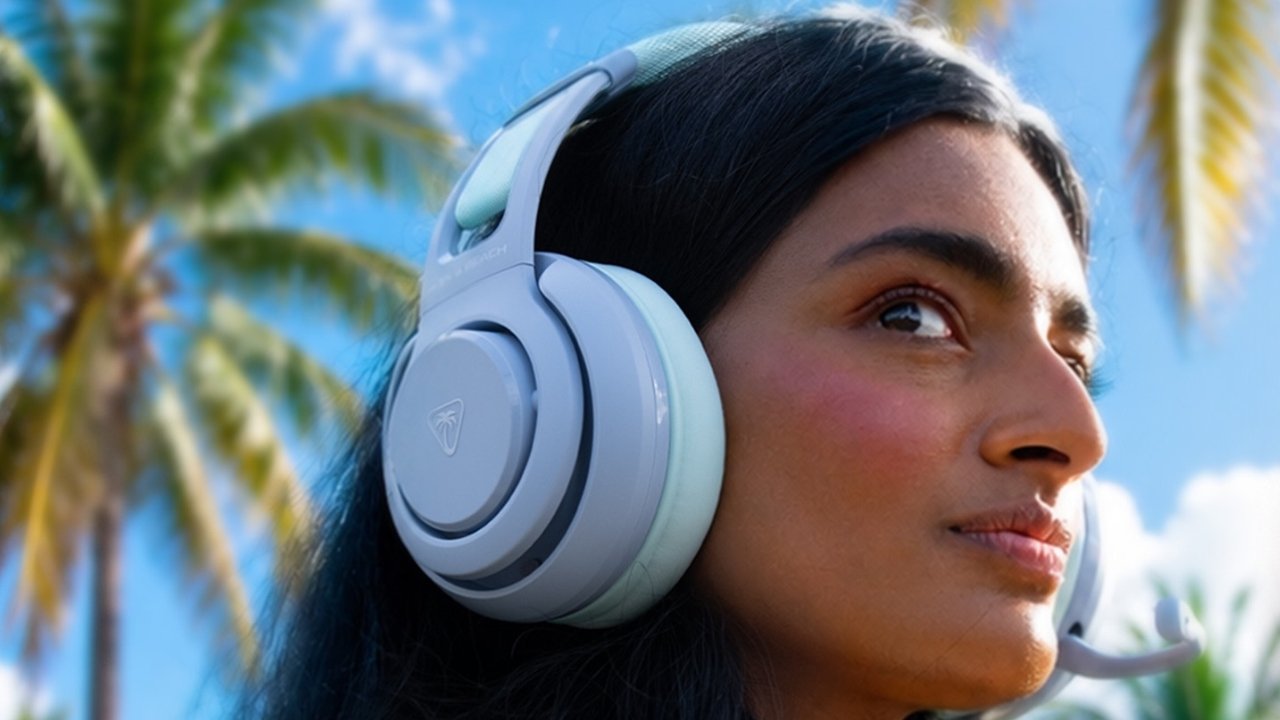
Is confusing Turtle Beach gaming for a resort of the same name in the Gold Coast a valid mistake? Given that Sydney is currently shivering through single degree temps, I am going to give myself some grace and forgive myself for rocking up to the first Australian Turtle Beach Showcase event expecting to be greeted by sunny cocktails, and instead encountering Xbox accessories.
Was I surprised. Yes. Disappointed? Absolutely not. Especially when I realised that were was so much more to the brand than gaming headsets. (Even if they are actually renowned for being the best in the world).
For the unitiated, Turtle Beach (the tech brand. Not the Queensland hotel) is the gaming giant that’s spent the last decade quietly buying up, building out and levelling up until “headset company” stopped being an accurate way to describe it. No poolside mojitos, no day beds. Just a full ecosystem of gear that most serious gamers already have plugged in somewhere in their setup. Whether they clocked the branding or not.
It’s a point Turtle Beach ANZ head Marie Hogben drove home herself at the launch, telling the room straight up: “We are not a headset brand anymore. We are a very wide, diverse gaming accessory brand.”
Hogben, who’s clocked more than two decades in the industry, revealed she “did 13 years at Nintendo. Then I moved into distribution. Time flies when you’re having fun,” she added.
From Headsets to an Empire: A Very Brief History
Turtle Beach started with audio. Console gaming headsets that quickly became the industry benchmark, the kind of “best in the world” reputation that gets thrown around a lot in gaming but is, in this case, genuinely earned.
Then the empire-building began.
- 2015. Turtle Beach dipped a toe into PC gaming with its Impact range of keyboards, the first real signal that this was a brand with ambitions beyond your ears.
- 2019. The brand acquired German PC gaming outfit ROCCAT, instantly levelling up its mice, keyboards and PC peripheral credibility.
- 2024. Turtle Beach picked up console accessory manufacturer PDP, folding controllers properly into the fold.
- 2026. All of that consolidation has paid off, with Turtle Beach now sitting as a genuine market leader across the gaming accessories category, not just headsets.
It’s the kind of steady, deliberate growth strategy that turns “the headset brand” into “the brand that’s quietly in every part of your setup.”
The Portfolio: Bigger Than Ever
Here’s where the Gold Coast confusion becomes almost forgivable, because Turtle Beach in 2026 is unrecognisable from Turtle Beach a decade ago. The brand’s own tagline sums it up nicely: they’ve taken care of the serious stuff, so you don’t have to. Seriously unserious, if you will.
The current lineup spans six categories, each built for a slightly different kind of player:
- Headsets. Immersive, crystal-clear audio built for durability, comfort and cross-platform use.
- Controllers. Licensed, wired and wireless options, programmable and loaded with audio enhancements, for both console and PC.
- PC Peripherals. Keyboards, mice and mouse pads that lean hard into innovation, performance and design.
- Simulation. Flight and racing hardware for players who want their setup to feel like the real thing.
- Performance Play. The Victrix range of fight sticks and pro controllers, built for the competitive gamer who treats hardware like a weapon.
- Creator-Ready. Gear designed to look good, sound good, and be easy to talk about on stream.
The portfolio reflects how people actually play now: across platforms, across genres, and increasingly, in front of an audience.
The Standout Tech
A few pieces from the current range are worth calling out specifically, because they show exactly how far the brand has pushed beyond “just a headset company.”
On the audio side. The flagship headsets are packing certified high-resolution wireless and wired audio, CrossPlay 2.0 for switching wirelessly between up to four audio sources, advanced active noise cancellation, 60mm Eclipse dual drivers and Dolby Atmos spatial audio. Battery life isn’t an afterthought either, with two swappable batteries delivering up to 80 hours of use via a charging dock, plus a 9mm microphone with flip-to-mute and AI noise reduction for genuinely clear voice comms.
It’s this audio pedigree Hogben traces back to 2013, when Turtle Beach introduced its “superhuman hearing” EQ preset, an in-house technology tuned to amplify footsteps, reloads and other competitive cues. Her pitch to the room was blunt: “If you’ve ever lost a game online, you’ve probably lost the other 700 users to this technology,” she joked
For sim racers. Turtle Beach’s racing setup for Xbox and PC is a complete, authentic build: a custom direct-drive 3.2Nm force feedback motor, magnetic paddle shifters, a race management display and a customisable Hall-effect throttle and brake pedal assembly, all wrapped in racing-grade materials and tuned via a companion app across Xbox, PC and mobile.
On the keyboard front. The compact TKL design comes with a 4.3-inch touchscreen for profiles, macros, stats and app control, Hall Effect switches with rapid trigger and adjustable actuation, double-shot PBT keycaps and a slim 29mm chassis.
And for mice. The standout spec sheet includes 8K polling with 0.125ms latency, a 2.25-inch touch display for controlling DPI, profiles, macros and even OBS, a 24/7 dual-battery hot-swap power system, true 8K wireless performance, an Owl-Eye 30K sensor, Adaptive 4D scroll and Titan optical switches for instant, durable actuation, with onboard customisation supporting 33 functions across five profiles.
It’s a lot of very serious engineering hiding behind a brand that’s happy to poke fun at itself.
So no, there’s no Gold Coast sunshine, and no cocktails. But turns out an afternoon with the “other” Turtle Beach is a pretty solid trade.