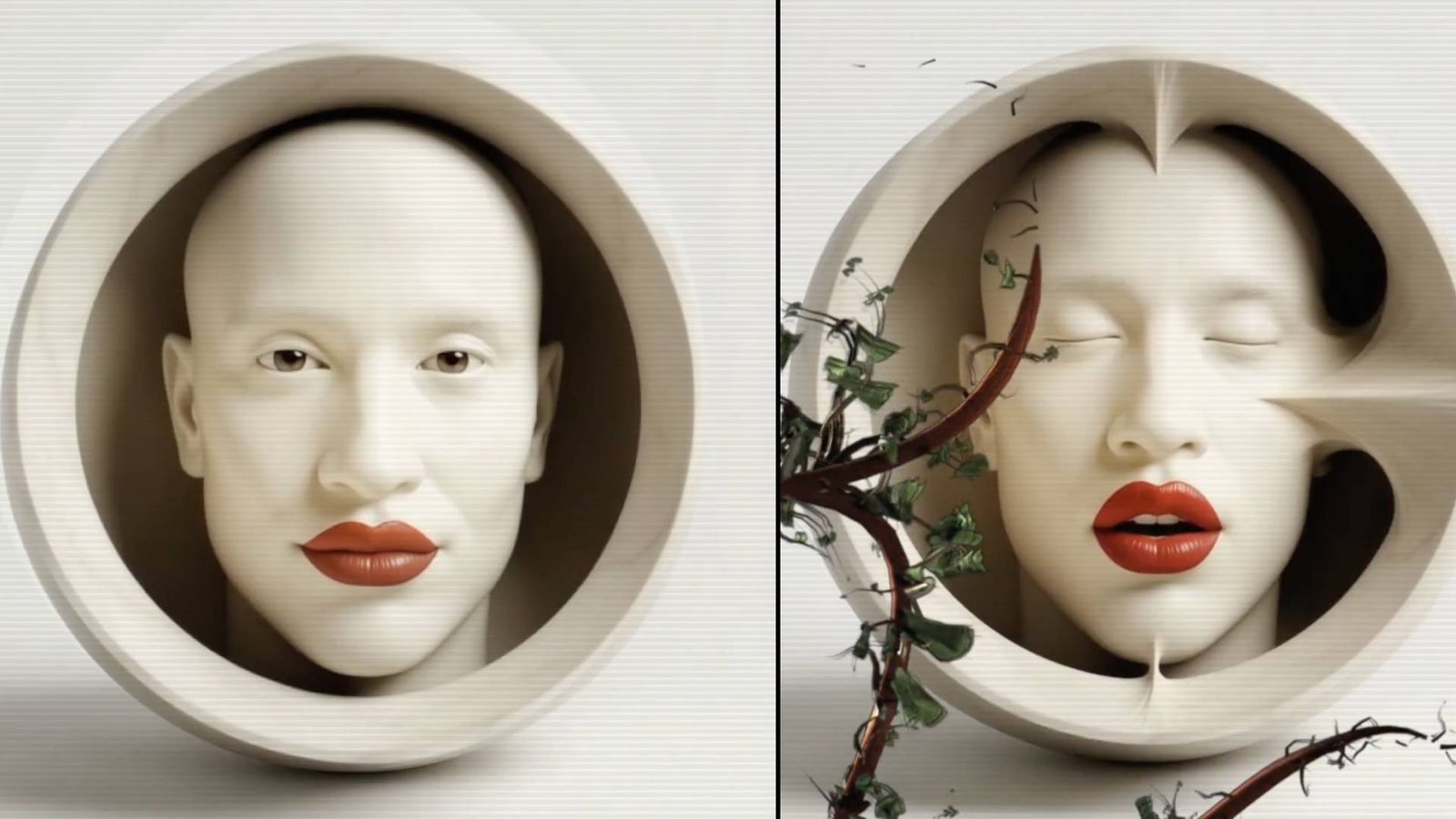
Confession – I used AI to make one of my most recent music videos. (E-Car Soul).
What’s so bad about that, you ask? Especially since the video is actually about how tech impacts our humanity.
Well, in the artistic community there’s a growing body of worry and anger around the technology. Not only the very real fear of being replaced, but also a hot, raging fury that the imposter AI has simply stolen real human work to repackage for someone else’s profit. You can see the problem.
So there’s now a burgeoning, militant agreement among many artists that we Just. Don’t. Use. It.
Inconveniently, I have endless curiosity around creativity, and I badly wanted to know whether working with AI was fun and creatively inspiring, before it became a cancel-able offence to do so.
First up, I created a basic image of my own face on a marble globe in ChatGPT. So far so good. But then I ran into problems.
When I asked ChatGPT to animate the image, it directed me on any number of wild goose chases, none of which resulted in an animation. Getting to the bottom of it was like asking your highly intelligent teenager about the newly empty bottles in the booze cabinet. The AI must have known I would get to the truth, but instead, in its charming way, it offered any number of possible explanations for its failed attempts.

Eventually I called it on its stuff – it finally confessed that in fact it COULD NOT do what I had asked it, and appeared to have known that all along. Sigh. We could have saved so much time. And I don’t need another teenager with honesty issues.
Eager to keep moving after hours of wasted time, I moved on to Runway, a top-flight video AI. It was a breath of fresh air as a personality: MUCH less chatty and much more productive, which by now I felt was something of a plus.
At first I found it exciting to type in prompts about my desired animations and let it do its thing. Some of the clips it generated from my initial image were startlingly unusual and compelling. But there was a strong element of inconsistency – the same prompt, re-used, would generate very different results, many of which were unusable or stylistically miles away from my goal. Eventually the human process became very dull – more about parsing prompt language and sorting through an array of animations before discarding many of them.
Eventually I did end up hiring a video production team to finish the video from my ideas and AI clips (the excellent Mazu Agency). I’m glad I did. Where the AI could only react to my prompts, and produced varying results that reduced my role to that of programmer and/or discerning gatekeeper, the human team understood exactly what I was after, and even improved on my ideas in exactly the way I would hope, all with a couple of emails. Their intuitive grasp and execution of my vision was gloriously uplifting after my AI experience.
Intelligence is more than an accumulation of information, I think, no matter what the Silicon Valley guys would have us believe. For sure the version of ChatGPT I used had some… ahem… shall we say, personality issues?
But creativity for me is so much more than poring through a lot of prompt-generated videos to see if anything in there matches my vision. I have made music and art since I was a child, because it fulfils a need in me, offers me a way to explore being human, and brings me joy. When I can, I collaborate with other artists because the human connection of shared experience, in pursuit of a common vision, is an exponential joy. Anyone who’s contributed to a potluck or sung in a choir knows that.
I have made music and art since I was a child, because it fulfils a need in me, offers me a way to explore being human, and brings me joy.
British Musician David Norland
A few months later I decided I would use AI to make a video for another track. I didn’t have much of a vision, but generated some initial prompts. Almost immediately I felt bored. Just flat. The creative novelty had worn off. Nothing about it felt authentic to my human reasons for making art.
It made me wonder if, for all the AI ethicists working at DeepMind, there are some vital questions we’re NOT asking. If we outsource everything to a competent facsimile of ourselves, what purpose remains for us? How can something that’s NOT human speak to the human experience?And who are we without the creative energy we have so far needed to survive, prosper, and grow? My theory, for what it’s worth, is that there may be a direct inverse correlation between the Moore’s Law curve (the rate of technological development)… and the human spirit.
While it was perfect for the E-Car Soul video, I don’t think I’ll use AI again.
About David Norland
David Norland is an English composer known for bringing stories to life through sound. Working between Los Angeles and London, his music spans screen, choral and electronic composition, with a distinctive ability to create atmosphere, emotion and narrative depth.
His screen work includes the score for the Emmy-nominated HBO film My Dinner With Hervé, starring Peter Dinklage and Jamie Dornan, as well as music for the Emmy-winning documentary Anvil! The Story of Anvil. He has also composed extensively for ABC’s primetime documentaries, including the award-winning 20/20, with his work broadcast widely across the US and internationally.
A chorister from an early age, David’s musical foundations began as a boy treble with The Elizabethan Consort of Voices. Today, he continues to explore traditional composition and modern sound design, blending human emotion with cinematic storytelling.
More about David Norland here: https://www.davidnorland.com/