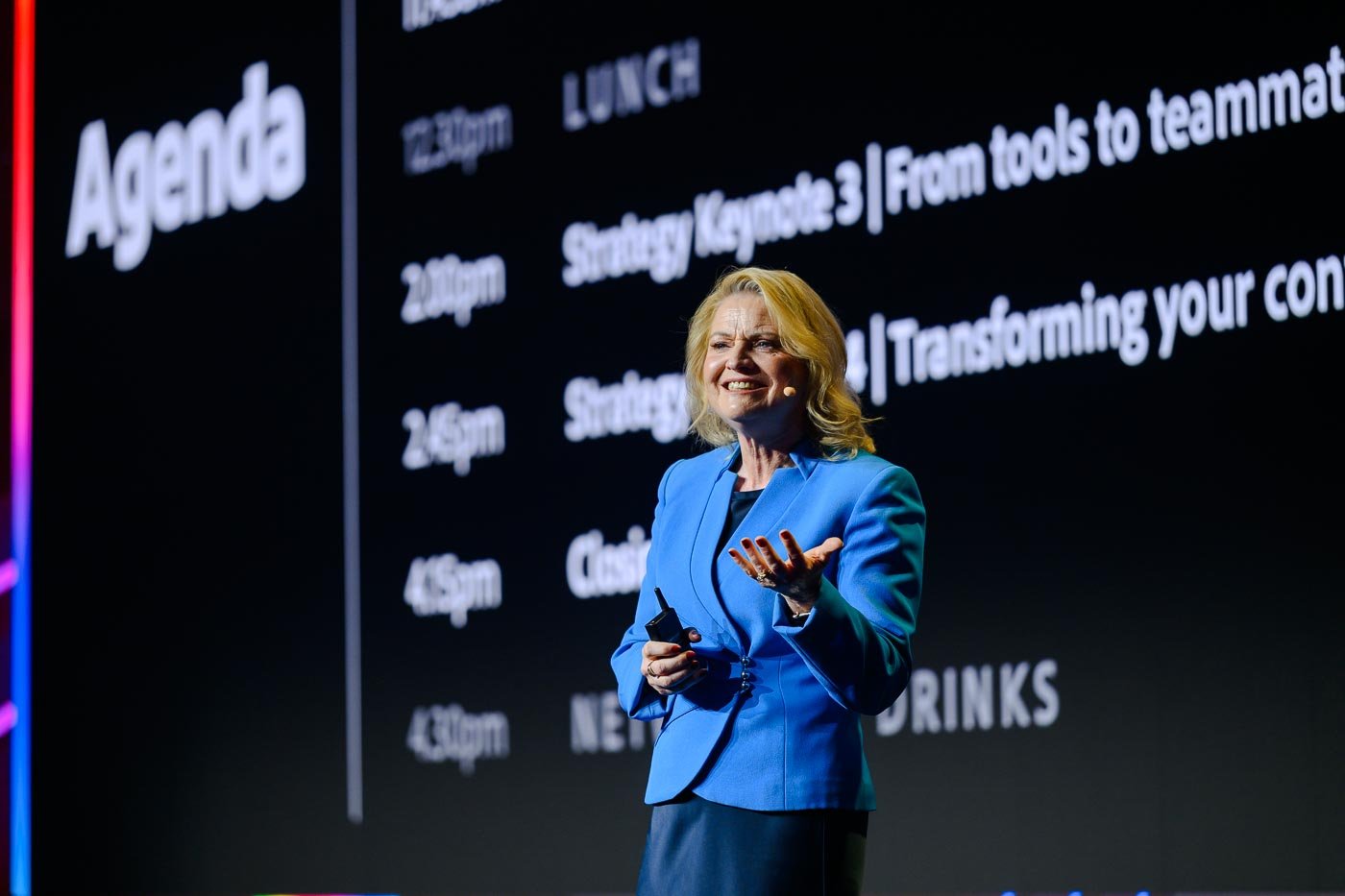
“You would never have thought businesses needed a strategy for computers, would you?” I ventured to Katrina Troughton, Adobe’s Managing Director for ANZ.
Without missing a beat, she said: “You absolutely do. Because they all look for different things.”
Katrina had just stepped off stage after delivering her opening keynote at Adobe Summit Sydney and our conversation made me think for the first time how businesses are now being found online. And it points to one of the biggest shifts now facing brands: content is no longer being created only for human eyes.
Increasingly, it also needs to be understood by machines. And this was the main thrust of the insights at this year’s Adobe Summit which was held at the International Convention Centre.
For decades, businesses built websites, articles, product pages, and campaigns largely around human readers and Google-led search. The aim was simple enough: we needed to create good content, optimise it well, and hope the right audience found it.
But that playbook has now been completely rewritten.
Today, consumers are turning to platforms such as ChatGPT, Perplexity, and other AI tools to ask detailed, back-and-forth questions before they ever land on a company’s website. We are not merely typing in a few keywords; we are asking for comparisons, recommendations, summaries, and personalised answers. At least that’s what I do, and we should all ask ourselves what we do now, now that we have our favourite AI tool to turn to, particularly when we want something in our daily life. Think shopping, our next holiday, the best tech appliance to buy, and the list goes on.
As Katrina explained, the customer journey is already becoming infinitely more complex.
“We are searching in not just one, sometimes several different chat platforms,” she said.
“We are double-checking it. We’re going to the website. And interestingly, when people do go to a website, it appears to be now with higher intent. So, the opportunity converts even higher.”
That changes everything. Brands now have a new audience they may not have fully considered before: AI. And not every AI platform reads, ranks, or recommends information in the same way.
“How do you enable your brand to be visible, whether it’s a human or a bot or one of the many LLMs that’s actually searching and looking for your brand?” Katrina posed.
It is a deceptively simple question, but it goes to the heart of the new search paradigm. In this next phase of the internet, it is no longer enough for a brand to be visible to people. It needs to be legible to machines.
One AI system may value authority. Another may prioritise clarity. Another may surface content based on how easily it can interpret a brand’s expertise, relevance, and trustworthiness. Businesses now need to make sure their content can be discoverable, understood, and served up by the AI systems increasingly shaping how people search, shop, and make decisions.
This was a central theme at the recent Adobe Summit. The conversation has moved beyond traditional SEO and into a new era of AI visibility, “AI visibility” is going to be part of our vernacular moving forward. For marketers, publishers, retailers, and founders, the implications are massive. A woman looking for a skincare product, a travel experience, or a financial service may no longer begin with a simple search result. She may ask an AI assistant to narrow down her options and recommend the best choice.
If your business is not part of that answer, you may never even make it into consideration.
This is why Adobe has introduced its new Adobe Brand Visibility solution, which brings together the now Adobe-owned Semrush’s AI visibility intelligence with Adobe’s agentic content optimisation capabilities. This tool allows marketers to access nearly 300 million real-world AI search prompts to understand how their brands are showing up across platforms like ChatGPT, Google AI Mode, Microsoft Copilot, and Perplexity AI. The aim is to give companies a clearer picture of whether their content is being found, how it is being interpreted, and where they may be missing from the conversation.
They’ve also launched Adobe CX Enterprise Coworker, an AI-powered teammate that automates customer experience and marketing workflows. Grounded in a brand’s business processes and customer context, it evaluates outcomes and drives coordinated actions across workflows to deliver the right experiences.
But Katrina is clear that AI is not just about corporate efficiency. At its best, it is about freeing people to think more deeply and communicate more powerfully.
“I think that everybody needs to think about the power of communication,” she said. “The opportunity now to have more ways you can communicate — that’s the part that’s a bit of a game changer.
Not just writing emails, but potentially turning it into a chart, creating an infographic, all these things that really lived in the domain of some incredibly talented people all of us have some access to now.”
Democratising Tech for Women
This equalisation is especially relevant for women in business and STEM. For years, access to high-end design, data visualisation, video production, and content creation has often depended on hefty budgets, specialist teams, or intensive technical training. AI is actively changing that narrative.
Katrina sees this as one of the most exciting aspects of the current technological shift.
“I’m absolutely an optimist,” she noted. “I think the opportunity to engage and really leverage all of your skills, your creativity, your thinking and the equalisation of that ability to be able to communicate . I really think that it can be a great new place that we can go.”
AI may be reshaping search, but it is also democratising the tools of communication. It is making it easier for female entrepreneurs and creatives to turn ideas into professional presentations, campaigns, and immersive customer experiences.
And contrary to the fear that AI will flatten creativity, Katrina believes the opposite is true.
“Despite everything, we still need and thrive on creativity and innovation and new ideas,” she said. The real opportunity is taking away the repetitive work that has traditionally consumed creative teams, tasks like resizing, adapting, and reworking content—so they can finally spend more time on the big-picture thinking.

Start in Your Everyday Life
Katrina’s advice for women looking to embrace this tech is refreshingly practical: do not wait for the perfect corporate AI strategy before experimenting. Start with the real problems in your own life.
“Find the use cases in your life, not just in your work,” she advised.
She gave a relatable example of being a mother managing the constant, chaotic flow of school newsletters.
“You get lots of newsletters from the school. Put them in a PDF, ask, ‘please create the schedule of what needs to be done on what day for what kid.’ Use the stuff in your real life. I assure you that one helped me an awful lot.”
AI is not just about enterprise transformation or the future of search. It is also about automating the mental load to make everyday life easier.
And that may be the real promise of AI. Not just more content, faster workflows or smarter search, but a way to reduce complexity and help us all communicate more clearly, creatively and confidently.

But for brands, the message from Adobe Summit Sydney is it’s no longer enough to be visible, it’s all about being AI Visible.