For years, skin care has been framed as a battle against time. Wrinkles, laxity, pigmentation – all positioned as visible “damage” to be corrected, smoothed or reversed.
But a new wave of skin science is shifting that narrative entirely.
What if ageing skin isn’t just breaking down… but losing its instructions?
That idea drives a growing area of dermatological research often described as skin communication science – which shows that youthful skin depends not only on what it contains (collagen, elastin, hydration), but on how efficiently its cells communicate with each other And over time, that conversation becomes quieter.
Cells don’t stop functioning overnight. Instead, they gradually lose the signalling clarity that tells them when to repair, when to renew, and how to maintain structural strength. The result isn’t just surface change – it’s a systemic slow down in how skin behaves.
In other words: skin doesn’t just age. It starts to forget.
The “memory” problem in skin biology
The comparison isn’t purely poetic.
Biologically, skin relies on a dense network of bio chemical messages to maintain function. Fibroblasts coordinate collagen production. Keratinocytes regulate barrier renewal. Immune cells respond to environmental stress. All of it depends on constant, precise signalling.
As we age, that signalling becomes less efficient. Receptors respond more slowly. Messenger molecules degrade faster. The skin’s internal “instruction system” loses fidelity.
This is why younger skin appears to bounce back quickly after stress, while mature skin tends to linger in states of dehydration, inflammation or fatigue. It’s not just structural loss – it’s communication breakdown.
And this is where one of skin care’s most talked-about biological concepts comes in: exosomes.
Exosomes: the skin’s forgotten language
Exosomes are nano-sized vesicles released by cells. Think of them as microscopic courier packages carrying proteins, lipids and genetic material from one cell to another.
Their role is fundamentally communicative. They help coordinate repair, regulate inflammation, and support regeneration pathways. In youthful skin, this messaging system is active and responsive. But like other cellular functions, it declines with age.
In skin care science, researchers now explore exosomes as a way to “restore dialogue” within the skin — not by forcing activity, but by reintroducing the signals that tell skin how to behave.
Or as researchers increasingly frame it: exosomes help skin remember its function.
This is where the language of “memory” becomes more than metaphor. It describes a functional attempt to reactivate the skin’s own regulatory intelligence – particularly processes tied to firmness, hydration and repair.
From signalling theory to skin longevity
This shift toward communication based skin care sits under a broader concept gaining traction in dermatology and cosmetic science: skin longevity.
Rather than focusing solely on short-term correction, skin longevity approaches aim to support the long-term resilience of skin systems – including elasticity, density, barrier integrity and radiance.
It’s less about erasing age, and more about maintaining performance.
A key development in this space is the integration of multiple signalling technologies – including peptides, growth factors and exosome inspired systems – designed to work across different biological pathways at once.
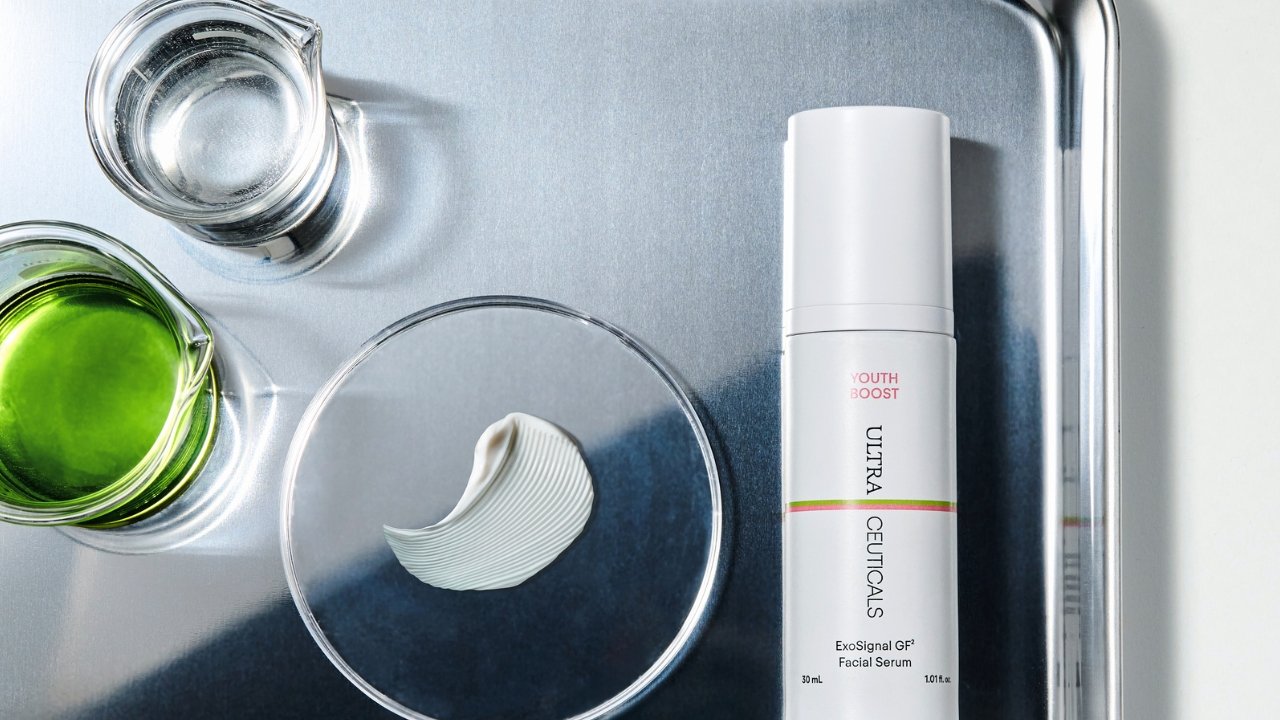
One recent example is Ultraceuticals’ Youth Boost ExoSignal GF2 Facial Serum, which brings together plant derived exosome science and stabilised growth factor technology in a single formulation designed to support cellular communication networks associated with renewal and structural support.
At the core of its approach is a plant-derived peptide–oleosome fusion system, designed to help stabilise and deliver signalling molecules that influence how skin repairs and regenerates over time.
In practical terms, it reflects a broader scientific direction: instead of overwhelming skin with activity, the goal is to restore the conditions for better internal coordination.
Growth factors, peptides and the evolution of signalling science
To understand where this fits in the science time line, it helps to separate the key players.
Peptides are short chains of amino acids that mimic biological signals, often used to encourage processes like collagen support or surface renewal. They’ve been a mainstay of modern skin care because they act as relatively simple “instructions” for skin cells.
Growth factors, however, operate at a more complex level. These are naturally occurring proteins that bind directly to cellular receptors, triggering deeper regenerative pathways involved in structural support, renewal and barrier recovery.
The challenge has always been stability – growth factors are fragile and degrade easily in traditional cosmetic formulations.
This is where delivery systems become critical.
In newer biotech driven approaches, lipid based structures such as oleosomes are being explored as protective carriers. By binding active molecules to these plant derived lipid reservoirs, the aim is to shield them from degradation while improving compatibility with the skin’s own lipid architecture.
It’s a technical solution to a very simple problem: how to keep a biological message intact long enough to be received.
Skin as a system of signals, not surfaces
What makes this shift interesting isn’t just the technology – it’s the reframing of what skin is.
For decades, skin care has largely treated skin as a visible surface to be corrected. The emerging view is more systemic: skin as an adaptive communication network.
Within that framework, visible concerns like fine lines, uneven tone, loss of firmness or dehydration stem from slower or disrupted signalling rather than existing as isolated issues.
That shift also explains why many newer formulations position themselves less as “treatments” for single concerns, and more as support systems for multiple visible dimensions of skin health – including elasticity, density, radiance and resilience.
The idea is not to over ride skin behaviour, but to improve its internal co ordination so that multiple functions – repair, hydration, barrier maintenance – can operate more efficiently together.
The future of “remembering” skin
The concept of making skin “remember” is still evolving, and it sits at the intersection of biology, biomimicry and material science.
But the direction is becoming clearer: skin care is moving away from isolated actives and toward multi-pathway communication systems that attempt to restore biological dialogue.
Whether through exosomes, growth factors or plant derived signalling complexes, the underlying question remains the same – can we help ageing skin regain the clarity of its internal instructions?
Because if skin ageing is partly a story of forgotten signals, then the next chapter of skin care may not be about adding more activity.
It may be about helping skin remember how to do what it already knew.