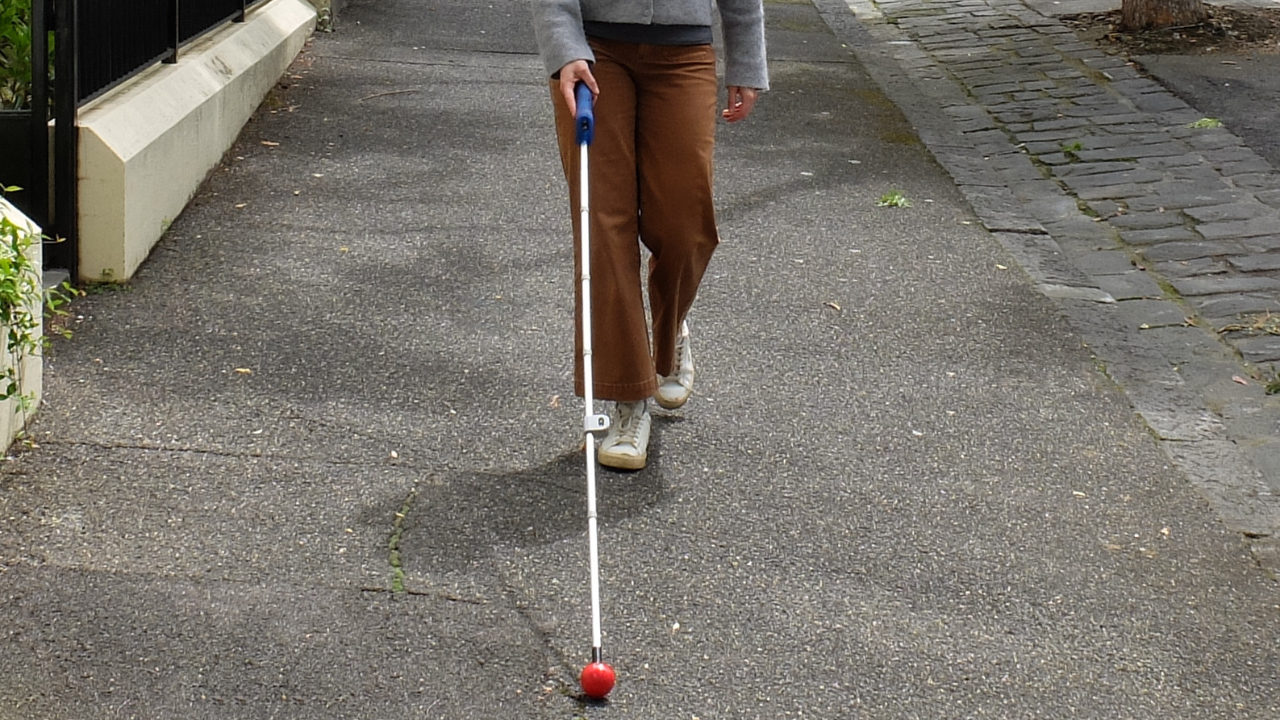
Tom Poletti was 24, in a lecture hall in Melbourne, when he realised the biggest blind spot in mobility technology wasn’t on the ground – it was above eye level.
Overhanging branches. Open cupboard doors. Scaffolding poles. Awning edges. For someone using a traditional white cane, these are invisible until the moment of impact. The cane, a design largely unchanged for nearly a century, sweeps the path ahead at ground level – brilliant at finding kerbs and steps, useless against a low-hanging sign.
That gap is what led Poletti, a student at Swinburne University of Technology, to spend the past year designing Clear Step – a smart mobility device that has just been named the Australian National Winner of the James Dyson Award 2026.
Building On, Not Replacing, What Already Works
Poletti’s instinct wasn’t to throw out the white cane. Millions of people have spent years training their hands, ears and instincts around it. Instead, Clear Step layers new senses on top of old skills.
Borrowing forward-detection principles from self-driving cars and drones, the device scans the space ahead for obstacles at head height and above – the exact zone a cane can never reach. When it detects something in the user’s path, it doesn’t just beep a warning into an already sound-reliant world. It speaks through touch.
A vibrating handle pulses to flag an approaching hazard. And in a detail that shows just how much thought went into the human holding the device, an integrated pin actuation mechanism raises small dynamic pins beneath the user’s index finger – a physical, private signal of how close danger really is. No noise. No guesswork. Just information, delivered the way a cane user already reads the world: through their hands.
It’s a small mechanical gesture with an outsized promise – the chance to walk a familiar street without flinching at what might be hanging just above the shoulder.
None of it came together in a single flash of inspiration. Clear Step went through round after round of smaller prototypes – different pin mechanisms, different hinges, different motors and housings – refined over hours of testing and, crucially, in consultation with mentors and with people who are blind. Judges kept returning to that last detail: Poletti didn’t design a solution for a community from the outside – he shaped it alongside them
“It feels amazing to be recognised for Clear Step and the prize money could really help to propel this project further,” Poletti said. “I have been developing the project in my spare time and aim to test a new prototype soon. The prize money would help considerably for development, especially if I look to invest in injection mould tooling. There is still progress to be made before this is a readily available product but there is hope that Clear Step will become a new standard for blind mobility.”
The £5,000 national prize (roughly AU$10,000) will go straight back into that work – further testing, and deeper collaboration with orientation and mobility experts and the blind community who helped shape the design in the first place.
Why the Judges Couldn’t Look Away
For Dr Krithika Randhawa, Associate Professor at the University of Sydney Business School, it was the balance of engineering ambition and empathy that stood out. “What stood out to me about Clear Step was how thoughtfully it brings together engineering ingenuity and the lived experience of people with visual impairment to address a very real, yet often overlooked, problem,” she said. “Rather than asking users to adapt to a new technology, it builds on the familiar white cane to detect forward and head-height hazards, with the potential to significantly improve safety, confidence and independent mobility.”
Trevor Long, Editor of EFTM.com, put it more simply: the white cane is a tool “that had not only been around for a long time, but had such extreme potential impact to the visually impaired.” Clear Step, he said, “gives the user awareness far beyond just the touch of the ground around them.”
And for Guy Turner, Dyson’s Robotics Product Lead, the timing matters as much as the design. Our footpaths and streets are changing fast – more e-scooters, more delivery robots, more autonomous vehicles sharing space with pedestrians, often on public infrastructure that’s ageing rather than improving. “There are 43 million people who are totally blind, and hundreds of millions who experience moderate to severe impairment,” Turner noted. “Despite this, modern technologies have failed to meet their evolving needs as our urban spaces continue to change.” Clear Step, he added, “is simple to use, solves a clear need in an intuitive way, and applies an appropriate amount of technology to meet it.”
A Field of Problem-Solvers
Poletti isn’t navigating this path alone. This year’s judges named two fellow Australian students as runners-up, each tackling a very different but equally human problem – and each answering a question that starts with who do the tools we already have leave behind?”
Thomas Thwaites, from Queensland University of Technology, looked at the scars mining leaves on the Australian landscape and asked how reforestation could move faster. His answer, Teros, is a pneumatic handheld seed planter powered by a refillable CO2 canister. One trigger pull drives six hollow stainless-steel spikes into the ground, planting seeds at the correct depth all at once – and because the unit holds up to six different species, a single pass can plant a genuinely biodiverse mix rather than a single-species monoculture. It’s reforestation designed for scale, without the cost and weight of hauling saplings.
Zander Morris, also from Swinburne University of Technology, turned his attention to a quieter but just as urgent problem: keeping medicine safe in places where people can’t rely on the power grid. In regions where daily temperatures regularly exceed 30°C, heat can ruin biopharmaceuticals like insulin or antibiotics within hours. His device, Coolearth, needs no electricity at all – a recycled computer fan draws ambient air through a rocksalt-filled pan and a pair of internal ventilation tubes, using evaporative cooling to pull heat away from a central storage chamber. It’s an old idea, the pot-in-pot cooler, made smarter and more effective for the people who need it most.
What Connects Them
Three students. Three unrelated fields – accessibility, ecology, healthcare. But look closely and the same instinct runs through all of it: notice the everyday failure point nobody else is looking at, and design, quietly and precisely, to fix it.
That’s the spirit the James Dyson Award was built to reward – engineering that starts with a real person’s real problem, not the other way around. For Tom Poletti, that person could be a commuter, a parent, a grandparent – anyone who has ever trusted a cane to tell them the way was clear, only to learn the hard way that “clear” only ever meant underfoot.
What Happens Next
Clear Step now moves forward alongside Teros and Coolearth to the international stage of the James Dyson Award. A global panel of Dyson engineers will name a Top 20 shortlist on 14 October, before Sir James Dyson himself selects the global winners on 4 November – each taking home £30,000 to push their invention further still.
It’s the latest chapter for an award now in its 21st year, one that has backed more than 400 student inventions with over £1.5 million in prize money across 28 countries. Around 70% of past global winners are still pursuing their inventions full-time – a reminder that for the students behind them, this was never just a competition entry. For Tom Poletti, it’s one step closer to a world where “clear” finally means clear all the way up.